
A $1,399 Power Station Just Changed the Caravan Off-Grid Equation
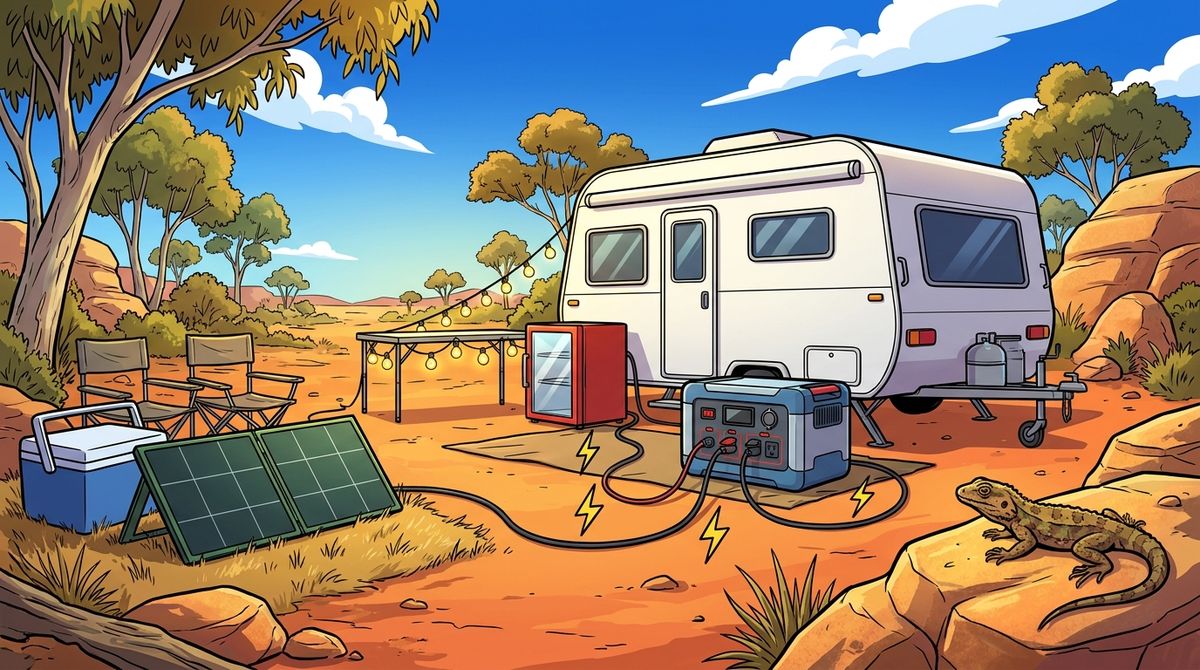
This week, global battery brand Anker SOLIX launched its S2000 portable power station in Australia — and it didn't launch it into the tech market. It launched it squarely at caravanners.
The pitch: 2kWh of lithium iron phosphate storage, 1,500W of continuous output, a 16.2kg vertical form factor, and a price tag of AUD $1,399 [1]. For context, that's roughly the cost of a mid-range caravan awning — for a battery that can run your camp fridge for days without a powered site.
Anker SOLIX's Australian market representative framed the launch around exactly the use case the numbers suggest: "There's a real sense of freedom in getting away from it all and exploring the outdoors. For caravan and outdoor enthusiasts, having power you can count on makes those adventures more comfortable and enjoyable. We created Anker SOLIX S2000 with that freedom in mind, giving people dependable, long-lasting power in a compact design, so they can go further, stay off-grid longer and make the most of every adventure." [1]
It's a crowded category — and the interesting part of this launch isn't the capacity or the price. It's what Anker is choosing to compete on.
The Specs: What the S2000 Actually Is
| Spec | Detail |
|---|---|
| Battery | 2kWh, 314Ah lithium iron phosphate (LFP) |
| Output | 1,500W continuous, 3,000W peak, pure sine wave |
| Idle draw | 10W with outlets live, 2W in standby |
| Efficiency | >90% at 100W loads (company-claimed, TÜV SÜD-verified runtime) |
| Size / weight | 208 × 282 × 323.3 mm, 16.2 kg, vertical design |
| Noise | 30 dB under 600W, no emissions |
| Longevity | 10,000 charge cycles, 15-year rated lifespan |
| Price | AUD $1,399 |
Source: Anker SOLIX via ChannelLife Australia, 23 September 2026 [1]
On paper, that's a solid but not radical 2kWh unit. What Anker is actually selling is efficiency at the low end — and that's a more interesting story for caravanners than it first appears.
Why Low-Load Efficiency Matters More Than Big Numbers
Here's the thing the marketing banners don't explain. Most caravan and camping power use isn't a kettle or an air conditioner. It's a portable fridge cycling on and off, some LED lighting, a phone charger, maybe a router — loads that sit between 20W and 150W and run, in total, for days.
At those loads, the enemy isn't capacity. It's waste. A power station drawing 30–50W just to keep its own inverter and electronics alive will burn through a meaningful chunk of a 2kWh battery overnight doing absolutely nothing. That's the difference between a fridge running for four days and a fridge running for two.
Anker's answer is what it calls OptiSave — changes to transformer and magnetic design, adaptive load control, and operating strategies aimed squarely at standby and low-load losses [1]. The claimed numbers: a 10W idle draw with outlets kept live, dropping to 2W in standby, and better than 90% efficiency at a 100W load. As a working example, Anker says its EverFrost 58L car fridge can run for up to 10 days at 4°C on the S2000 — presented by the company as an illustration under test conditions rather than a guaranteed figure, but a useful indicator of the design intent [1].
The TÜV SÜD verification on runtime is worth noting too. Battery runtime claims in this category have a long history of optimism, so third-party testing is a trend worth encouraging — whatever brand you end up buying.
What 2kWh and 1,500W Will (and Won't) Run
The honest maths, using the S2000's own limits:
Comfortably:
- Portable fridge/freezer (40–60W average while cycling) — days at a time LED lighting, phone/laptop/camera charging, fans Starlink or 4G router — continuous Small coffee machine or toaster at 1,500W — short bursts
Marginal or no:
- Standard electric kettle (~2,000W+) — will trip the 1,500W continuous limit (3,000W peak helps motor startup, not sustained loads) Air conditioning — not a chance on 1,500W Anything with a big heating element run for long periods
That's not a knock on the S2000 — it's the reality of the entire 2kWh class. The 3,000W peak rating handles inductive loads (fridge compressors, power tools) kicking in; it doesn't turn 1,500W of continuous output into 3,000W.
Power Station vs Generator: The Question That's Actually Changing
For decades the off-grid caravan answer was a petrol generator. That comparison is shifting, for three reasons this launch typifies:
- Noise and emissions. The S2000 runs at 30 dB under 600W with zero exhaust — which matters in an increasing number of locations where fuel generators are restricted or banned, and matters even more to the neighbouring van at 6am [1]. Low-load economics. Generators are inefficient at the 50–100W loads that dominate camping. A big inverter generator idling along to run a fridge is burning fuel to power mostly itself. Battery doesn't care. Indoor-adjacent use. A battery can live in the van's front boot or even inside; a generator can't.
The generator still wins for sustained heavy loads and indefinite runtime with fuel on hand. But for the typical long-weekend to two-week trip pattern — which, per the Caravan Industry Association of Australia's State of the Industry 2026 report, is where Australian travel actually sits (average trip length of 3.4 nights across 17.3 million caravan and camping trips and $12.6 billion in trip spend in 2025) — the battery case is now genuinely competitive [2].
The Other Number That Matters: 10,000 Cycles
The S2000 uses lithium iron phosphate (LFP) cells — the chemistry that has become the default in this category because of its durability and thermal safety profile compared with older lithium-ion formats [1]. Anker rates it for 10,000 charge cycles and a 15-year service life [1].
Practically: if you bought one tomorrow and cycled it every single weekend, you'd hit 1,000 cycles in about 20 years. Cycle life is not going to be the failure point. That's a meaningful shift from the AGM batteries most vans still carry, which degrade noticeably within a few years of regular deep cycling — and it's why buying on rated lifespan, not just upfront capacity, is the smarter comparison when you're weighing up options.
How to Size Portable Power for Your Van or Boat
Whether the S2000 is the right unit or not, the method is the same:
- Audit your real loads. Add up the watts of what you actually run: fridge (check its average, not peak), lights, chargers, any medical devices. Multiply by hours per day to get watt-hours. Size storage at 2× your daily need. A 2kWh unit comfortably delivers ~1.6kWh of usable energy in practice (you don't run batteries to zero, and losses exist). If your daily draw is 600–800Wh — a typical efficient camp setup — that's two days, three if you're frugal. Check the continuous output, not just capacity. If you want to run anything over ~1,200W, this class of unit isn't it, regardless of brand. Factor recharge. The S2000 can top up from solar, 240V, or a vehicle. Off-grid for a week means your solar blanket matters more than your battery — budget for it. Weight and form factor are specs too. 16.2kg in a vertical footprint that slides into a caravan compartment is a very different ownership experience to a 30kg slab that lives on the floor.
The Same Maths Applies On the Water
Caravanners aren't the only ones doing this calculation. Portable power stations have quietly become standard kit on Australian trailer boats and small cruisers — running the bait fridge or esky, keeping sounder and chartplotter memory alive at the mooring, charging dive torches and cameras, and powering the night's anchorage without running the main engine or a noisy portable generator.
The sizing method above transfers almost directly, with two boat-specific caveats:
- Marine environment. A van's front boot is kind to electronics. A boat isn't. Whatever unit you choose needs to live somewhere dry and ventilated, secured against rolling, and ideally out of direct sun. The S2000's vertical, 16.2kg format is easier to stash in a cabin corner than most slab-style units [1], but no portable power station is marine-rated gear — treat it like any other 12V/240V accessory, not like something that belongs in the bilge. Salt and warranty. Check the warranty conditions for marine-adjacent use before assuming a consumer electronics warranty covers life on a boat.
For day-boats and weekender owners, though, the category shift is the same as it is for caravanners: the kind of battery that used to mean a specialist install is now a $1,399 appliance you carry aboard. That's changed what's worth running at anchor — and what's worth leaving at home.
The Bottom Line
A 2kWh LFP power station at $1,399, tuned for the low-load reality of camping rather than headline capacity, tells you where the category is heading: quieter, lighter, longer-lived, and cheap enough that off-grid power is now a mainstream purchase rather than a premium one. Competition from global brands like Anker also puts genuine price pressure on the established Australian players — which, as anyone who priced a lithium setup three years ago knows, is overdue.
If you're setting up a van or a boat for off-grid use, this is a good week to be shopping.
And if your idea of getting off-grid involves skipping the van altogether — Cat Cruisers builds electric boat-caravans such as the 870 on the Gold Coast, where the powertrain is silent and the only thing you need to recharge is yourself. Explore the range at catcruisers.com.au.
Sources
1. Sean Mitchell, ChannelLife Australia, "Anker SOLIX launches S2000 power station in Australia", 23 September 2026. https://channellife.com.au/story/anker-solix-launches-s2000-power-station-in-australia
2. Caravan Industry Association of Australia, "State of the Industry 2026 (via GoRV coverage)", 2026. https://gorv.com.au/state-of-the-australian-caravan-industry/