
Always be charging: how Fortescue plans to run electric haul trucks BHP says can't work
Two weeks ago, Australia's two biggest iron ore miners went public with opposite conclusions about the same question: can a battery-electric haul truck do a diesel truck's job in the Pilbara? BHP said no — at least not yet. Fortescue said yes, and accused its rival of missing the bigger picture.
Now Fortescue has put meat on the bones of that argument. In new detail reported by The Driven last month, the Andrew Forrest-controlled miner has spelled out the operating playbook it will use when the first of its battery-electric haul trucks arrives on site before the end of the year — and the strategy has less to do with the trucks themselves than with when and how they plug in.[1]
The core idea is one that owners of electric cars will find familiar: the problem is not charging time, it's charging timing.
Six 15-minute top-ups, not one long charge
Fortescue's own modelling says its battery-electric haul trucks will need six charging sessions a day, of about 15 minutes each. BHP's planning, by contrast, assumes six to eight 30-minute stops over a 24-hour cycle — enough lost time, BHP told an investor roundtable earlier this month, to cost a battery-electric truck around 1,000 operating hours a year compared with a diesel equivalent.[2]
Fortescue's answer is to stop treating charging as a separate activity and start treating it as something that happens in the gaps.
"A truck's charge time on its own doesn't tell you how efficiently it can operate across a shift," Warren Harris, Fortescue's director of Decarb and Green Product Delivery, told The Driven. "We're redesigning how the fleet works, using short, opportunistic top-ups to reduce charging downtime and keep trucks moving."[1]
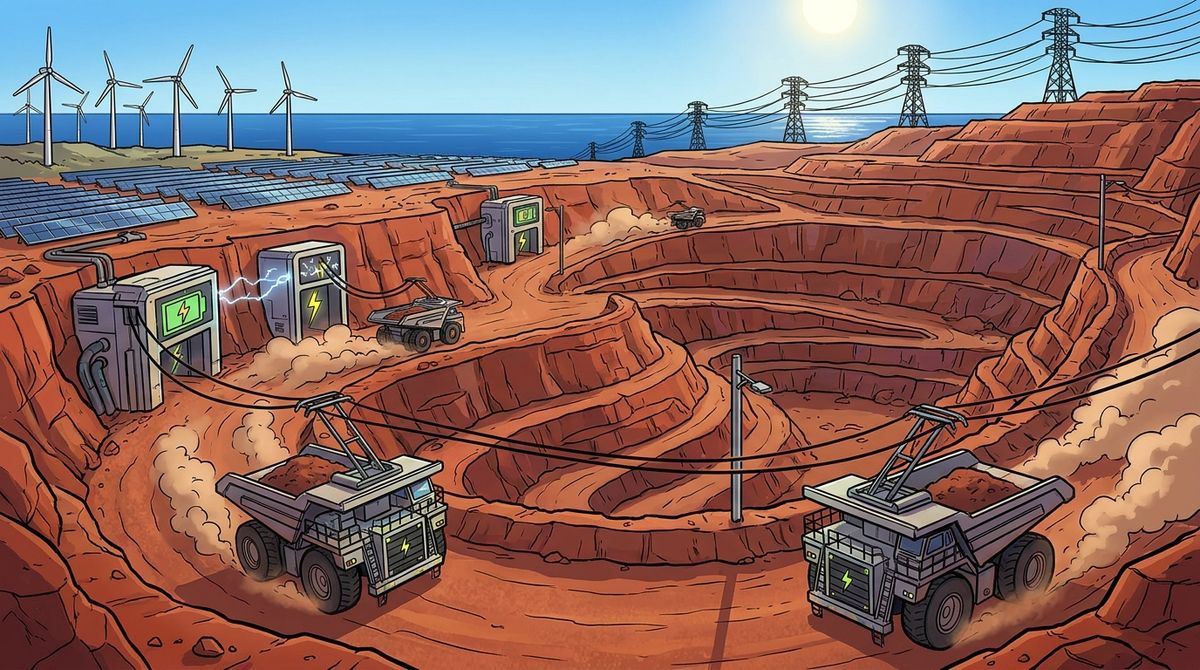
In practice, that means 6 MW fast chargers positioned near excavation sites, so trucks can top up while they queue for loading — downtime that exists anyway. It means scheduling charging around renewable generation, treating each truck as what Harris calls "batteries on wheels" that can absorb solar and wind when it's abundant. And it means taking credit for the things electric drivetrains do better: faster acceleration on haul roads, and roughly 350 fewer maintenance hours a year, which Fortescue says works out to about an extra hour of availability per truck per day.
Add it up, says Harris, and "our current modelling puts electric haul trucks at total cost of ownership parity with diesel, using conservative assumptions around charging downtime, truck speeds and service intervals."[1]
The rollout is already in motion
This is not a concept study. Fortescue's delivery timeline is concrete:
- Late 2026: the first Liebherr-built battery-electric haul truck arrives on site, followed quickly by 10 more — enough to electrify haulage at its first ore pit 2028: the first trucks from China's XCMG arrive, part of an agreement that could scale to as many as 200 battery-electric haul trucks in the Pilbara[3] End of the decade: the last diesel haul truck phased out, in line with Fortescue's "real zero" 2030 target
The supporting fleet is further along than most realise. Fortescue's 20th electric excavator is already on site and, the company says, is out-producing the diesel machines it replaced — by the end of 2026, 40 per cent of its digger fleet will be electric. Its first electric XCMG wheel loader is en route, an electric grader is on the way, and two 14.5 MWh battery-electric locomotives are already trialling, with overhead pantographs now under consideration after the company concluded its original plan to regenerate power on downhill runs to port won't deliver. Even the light fleet is turning over: Fortescue has taken delivery of its first battery-electric Toyota HiLux utes.[1]
Powering all of this requires a grid of its own. Fortescue has 1.2 GW of solar, more than 600 MW of wind and 4,000 MWh of battery storage due in place by the end of 2028 to supply the fleet.[1] The full transition carries a price tag of around $6 billion in new energy infrastructure, part of the company's commitment to reach "real zero" — no gas or diesel burnt for power, vehicles or equipment — at its Pilbara operations by 2030, a materially more aggressive target than BHP's net zero by 2050.[5]
BHP is solving a different problem
None of this means BHP is wrong about its own numbers. The 1,000-hour figure BHP presented on September 16 is a modelling estimate for a theoretical 220-tonne-class truck with a 3 MWh battery doing six to eight static charges a day — and BHP has been careful to note it is not downtime recorded in its Jimblebar trials, which have logged more than 100 hours and 200 test laps across two Caterpillar 793 XE "Early Learner" trucks.[2][4]
BHP's response to the productivity question is different rather than dismissive: it will trial Caterpillar's Dynamic Energy Transfer (DET) system — effectively an overhead power rail that charges trucks as they drive — at Jimblebar in FY27, alongside high-power static charging infrastructure. If a truck never has to stop to charge, the haul-cycle maths changes entirely.[2]
The two strategies reveal the actual fault line. Fortescue is betting that fleet operations can be redesigned around opportunistic charging using technology that exists today. BHP is betting that the answer is a charging infrastructure breakthrough that keeps trucks moving continuously. Both are spending real money finding out, and both are publishing their reasoning — unusually transparent for an industry that typically treats operational detail as commercially sensitive.
Why this matters beyond the Pilbara
The outcome of this contest will shape more than two balance sheets. Haul trucks are one of the hardest machines on earth to electrify — they run 24 hours a day in dust and heat, far from any grid, with downtime measured in thousands of dollars per hour. Whatever charging strategy, duty-cycle redesign and maintenance model emerges from the Pilbara will filter down to every heavy electric vehicle sector in Australia, from port logistics to quarrying to regional road freight.
It also frames the policy conversation. Miners asking governments for grid connections, renewable zones and transmission investment can now point to specific fleet numbers rather than aspirations — and Fortescue's "charging when the sun shines" model is effectively a demand-management argument for more solar and storage, not less.
For fleets, contractors and site operators watching from the sidelines, the practical lessons are already visible:
- Charge in the gaps, not after them. Fortescue's plan works because top-ups happen during existing idle time (queuing, shift changes), not in dedicated downtime Count the whole operating picture. Maintenance hours, acceleration and availability matter to total cost as much as charging stops — BHP's own framing of the 1,000-hour figure includes none of the offsets Fortescue claims Match charging strategy to duty cycle. Static, dynamic, battery-swap and pantograph approaches are all being trialled in Australia or by Australian miners overseas (Rio Tinto is running a battery-swap trial with eight trucks in Mongolia); there is no single answer yet Watch the fleet orders, not the press releases. The clearest signal will be whether miners convert trials into volume orders — Fortescue's Liebherr and XCMG deliveries, and any expansion of the BHP–Caterpillar Early Learner program, are the numbers to track
The Australian EV Group will keep tracking both Pilbara programs as fleet data starts to land — the next disclosure worth waiting for is a hard figure: charging time per cycle, or tonnes per truck per shift, from either camp.
Sources
1. The Driven, "The simple tricks Fortescue is using to convert its fleet of giant diesel haul trucks to full battery electric", 25 September 2026. https://thedriven.io/2026/09/25/the-simple-tricks-fortescue-is-using-to-convert-its-fleet-of-giant-diesel-haul-trucks-to-full-battery-electric/
2. Australian Mining, "BHP puts 1000-hour figure on electric haul truck charging opportunity", September 2026. https://www.australianmining.com.au/bhp-puts-1000-hour-figure-on-elect
3. Australia Times, "Fortescue to deploy up to 200 battery-electric haul trucks in Western Australia", 2026. https://australiatimes.com/fortescue-to-deploy-up-to-200-battery-electric-haul-trucks-in-western-australia
4. Kalkine, "Rio Tinto tests two paths toward electric mine haulage", 2026. https://kalkine.com.au/news/mining/rio-tinto-asxrio-tests-two-paths-toward-electric-mine-haulage
5. The Driven, "BHP hits the brakes on electric trucks as it frets about charging times — but rival Fortescue says it's missing the point", 18 September 2026. https://thedriven.io/2026/09/18/bhp-hits-the-brakes-on-electric-trucks-as-it-frets-about-charging-times-but-rival-fortescue-says-its-missing-the-point/