
Ampol's $225m Evie takeover: what charging consolidation means for regional EV drivers
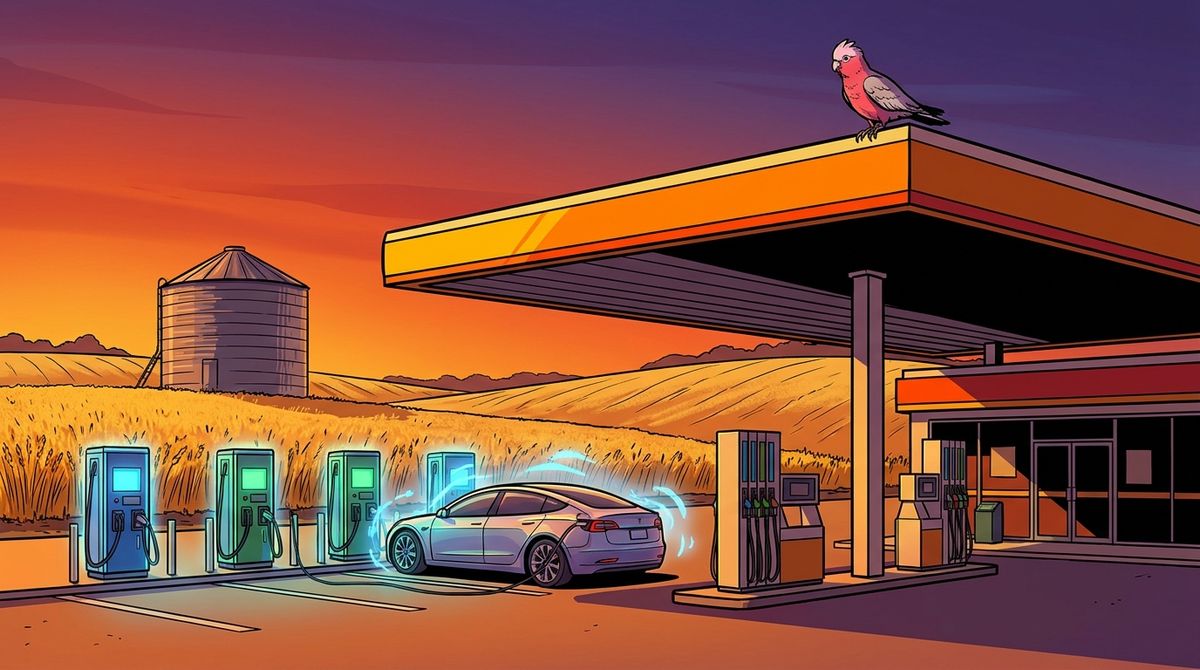
Australia's largest fuel retailer has made its biggest bet yet on the electric future. On 1 October 2026, Ampol announced to the Australian Securities Exchange that it would acquire Evie Networks — one of the country's largest public EV charging operators — for $225 million.[1]
The deal adds 1,031 DC fast-charging bays across 322 sites to Ampol's existing AmpCharge network, creating a combined footprint of roughly 1,425 charging bays at more than 400 locations nationwide.[2] Ampol chief executive Matt Halliday framed the move as simple customer service. "Our job is to be there for customers with what they need when they need it, as they choose vehicle technology that suits their needs," he said, calling EV charging "a question of disciplined investment at the right time."[3]
For a company whose core product has been petrol and diesel for more than a century, the timing tells its own story. New electric vehicle sales overtook petrol car sales in Australia for the first time in August, and the national BEV fleet passed half a million vehicles in recent weeks.[4] Ampol itself reported that charging sessions across its existing network grew 116 per cent in the first half of 2026, with energy supplied up 120 per cent year on year.[3]
The numbers behind the deal
This is not a symbolic acquisition. The detail in Ampol's ASX announcement suggests a carefully costed play for scale:
- Purchase price: $225 million, 100 per cent of Evie's operating company (Fast Cities Australia), fully debt-funded Evie footprint: 1,031 DC fast-charging bays across 322 sites, spanning metropolitan, regional and highway locations Combined network: approximately 1,425 bays at more than 400 sites, putting Ampol alongside Chargefox, Tesla, Jolt and NRMA as one of Australia's leading public charging operators[5] Tenure: Evie's sites carry a weighted-average lease expiry of around 10 years, with established grid connections and, in some cases, spare capacity for expansion[6] Financial targets: Ampol expects the combined charging business to reach around $30 million in annualised EBITDA within three years, breakeven in 2028, and roughly $10 million in cost synergies[6] Completion: targeted for the first half of 2027, subject to ACCC clearance[2]
Why a petrol company is buying electrons
Ampol's pivot has been building for years. The company first flagged EV charging in 2021 with plans to roll out rapid chargers across 121 service stations as part of a $100 million future-energy investment, formally launching AmpCharge in 2022.[2] Partnerships with Mirvac and Stockland have since pushed chargers into shopping centres and retail precincts, extending the network beyond the fuel forecourt.
But the strategic pressure is real. In July, Halliday told the ABC that declining petrol demand could eventually make fuel production at Ampol's Lytton refinery in Brisbane financially unviable, forcing a shift towards diesel and jet fuel.[4] Buying Evie is a hedge against that curve — converting service stations, site tenure and grid connections from petrol assets into charging assets.
Evie, founded in 2017 with backing from veteran energy investor Trevor St Baker, built much of its network along highway corridors and in regional centres — precisely the locations where long-distance EV drivers have felt least served. "Many of its locations had been built with expansion in mind," Evie chief executive Chris Mills said of the deal.[3]
Halliday also paid tribute to St Baker in the announcement, calling him "a genuine pioneer of Australia's BEV charging industry" whose "vision and capability have built Evie Networks' national platform."[6] That matters for continuity: the sites, tenure and grid agreements that make Evie valuable stay in place, and the people who understand the quirks of each regional location are likely to be retained through integration.
A crowded market getting more concentrated
The acquisition lands in a charging market that has quietly become competitive. Chargefox, backed by the motoring clubs, has been the default recommendation for reliable regional travel for years. Tesla's Supercharger network has opened to other brands across much of its footprint. NRMA, Jolt and a string of state-funded corridor programs have filled gaps on major highways. Ampol's combined network of ~1,425 bays would be among the largest single holdings in that landscape, but it is not unchallenged dominance — and the ACCC process will test exactly that.
What Ampol brings that most pure-play charging companies cannot is a national field-operations workforce and decades of experience keeping remote fuel infrastructure running. Anyone who has arrived at a regional fast charger to find it offline knows that uptime — not headline bay counts — is the metric that matters. If Ampol applies fuel-station service standards to charging, the deal could lift reliability across a big slice of the national network. If it simply harvests synergies, regional drivers will notice quickly.
What consolidation means if you drive, tow or run a fleet
For EV owners, charging network consolidation cuts both ways. On the positive side, a well-capitalised owner with service-station infrastructure means more reliable maintenance, faster fault response and the balance sheet to upgrade ageing chargers — a chronic complaint across older third-party networks. Ampol has already trialled heavy-duty hardware, installing Australia's first 400 kW ABB A400 ultra-fast chargers at a site on Sydney's M4 in February, with bays designed to accommodate electric trucks and larger vehicles.[7]
For regional drivers, caravanners and towing EV owners, Evie's highway and regional sites were among the few dependable fast-charging options outside capital cities. Their continued operation — and hopefully expansion of spare grid capacity at existing sites — matters more than branding.
The cautionary note is competition. When a fuel giant owns one of the largest charging networks, pricing power and roaming access become policy questions — particularly for drivers in one-horse regional towns where the Evie site may soon be the Ampol site, and the only DC fast charger for a hundred kilometres. The deal requires ACCC approval, and the regulator will weigh whether a combined Ampol–Evie entity can disadvantage rival networks or independent charging providers that rely on fuel-retailer sites. Ampol says the two networks will continue operating independently until completion, with full integration expected to take around three years after that.[6]
Practical takeaways
- If you're planning regional EV travel: the Evie sites you already rely on should keep operating through the transition, but expect gradual branding and payment-system changes through 2027–2029. If you tow: watch whether Ampol extends its M4-style high-power, large-vehicle charging bays to Evie's highway sites — towing-friendly infrastructure is the segment most likely to benefit from a capital-rich owner. If you run commercial vehicles or conversions: a consolidated network with 10-year site tenure and spare grid capacity is a stronger foundation for depot-adjacent and route charging planning than a fragmented one. At the Australian EV Group, we watch charging consolidation closely because dependable regional DC fast-charging is a core part of the business case for electric conversions and electric RV travel. If you're considering an EV conversion or an electric RV: network consolidation of this kind is a positive long-term signal — the infrastructure your vehicle depends on is attracting serious capital, and highway corridors are where that capital is going next. Check the charging map along your regular routes before committing to a battery and charging spec, and favour vehicles with CCS2 compatibility, which remains the dominant connector across both the Evie and AmpCharge networks. Watch the ACCC process: the regulator's decision will shape how open and how competitive the merged network must remain.
The bigger signal is cultural. When the country's biggest fuel retailer spends $225 million on charging bays — and says petrol refining is approaching an economic cliff — the transition to electric transport is no longer a forecast. It's balance-sheet reality.
Sources
1. carsales, "Ampol acquires Evie EV charging network", October 2026. https://www.carsales.com.au/editorial/details/ampol-acquires-evie-ev-charging-network-153151/
2. Drive, "Ampol buys Evie EV charging network as petrol sales slip", October 2026. https://www.drive.com.au/news/ampol-buys-evie-ev-charging-network-as-petrol-sales-slip/
3. The Nightly, "Electric vehicles: Ampol announces $225m deal to buy Evie Networks", 1 October 2026. https://thenightly.com.au/australia/electric-vehicles-ampol-announces-225m-deal-to-buy-evie-networks-c-22952929
4. Amit Chowdhury, Pulse2, "Ampol To Acquire Evie Networks For $225 Million", October 2026. https://pulse2.com/ampol-to-acquire-evie-networks-for-225-million
5. EVMAGZ, "Ampol to Acquire Evie Networks for AU$225 Million to Expand EV Charging Network", October 2026. https://evmagz.com/ampol-to-acquire-evie-networks-for-au225-million-to-expand-ev-charging-network
6. Ampol Ltd, ASX announcement — acquisition of Evie Networks (via Markit Digital CDN), 1 October 2026. https://cdn-api.markitdigital.com/apiman-gateway/ASX/asx-research/1.0/file/2924-03142904-2A1700918
7. ABB, "ABB and Ampol roll out first ultra-fast chargers in Australia", 2026. https://new.abb.com/news/detail/132939/abb-and-ampol-roll-out-first-ultra-fast-chargers-in-australia