
ARENA Backs Australia's Largest Vehicle-to-Grid Fleet Trial in the ACT
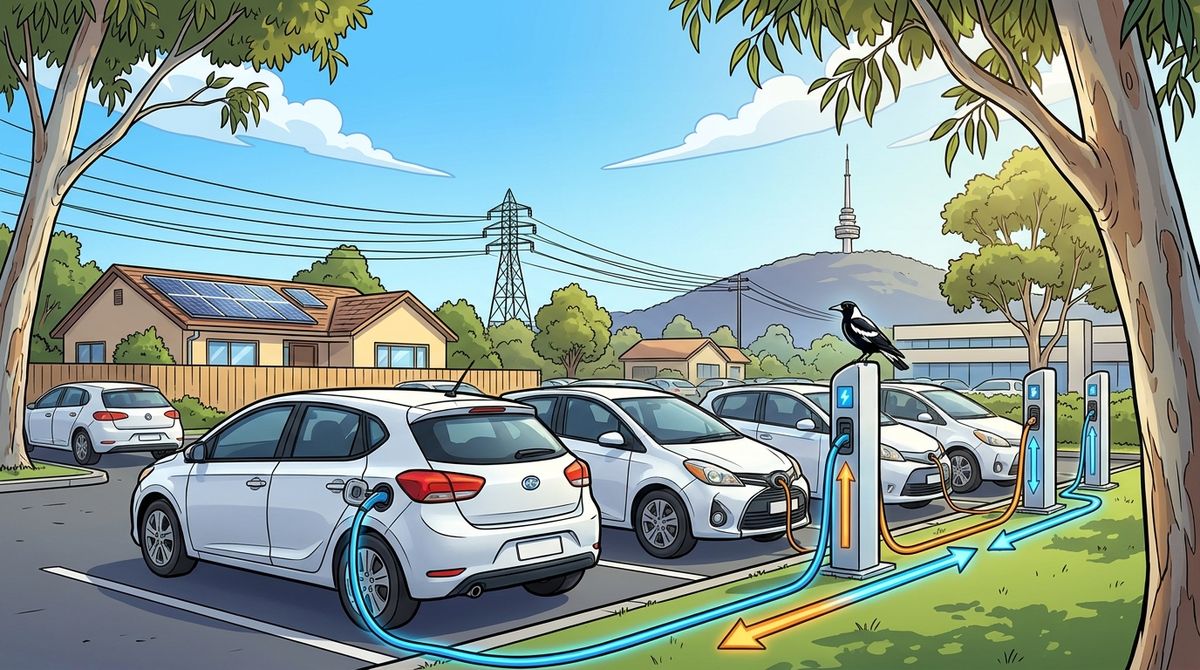
The Australian Renewable Energy Agency (ARENA) has committed $4 million to what it describes as Australia's largest commercial deployment of vehicle-to-grid (V2G) technology, with up to 130 electric vehicles and bidirectional chargers set to be rolled out across the ACT Government fleet.
Announced on 21 October 2026, the project — Realising Electric Vehicle-to-Grid Services 2 (REVS2) — will be delivered by charging infrastructure company JET Charge. It builds directly on Australia's first V2G trial, which ARENA funded in 2020 and which demonstrated that electric vehicles could safely export electricity back to the grid.[1]
The difference this time is scale and setting. Where the original REVS project proved the technology could work, REVS2 is designed to prove it can work inside the everyday operations of a large commercial fleet — the missing piece, according to ARENA, for bidirectional charging to move from trial to mainstream adoption in Australia.
What REVS2 involves
- Funding: $4 million from ARENA, delivered to JET Charge Fleet size: Up to 130 electric vehicles with bidirectional chargers across the ACT Government fleet Scope: Testing how fleet EVs can support the grid while still meeting day-to-day transport needs Context: Part of ARENA's broader bidirectional charging work, including the national Bidirectional Charging Roadmap funded in 2025
The announcement also coincides with Australia's first Open Charge Alliance Plugfest event in Canberra, supported through the ARENA-funded Vehicle-Grid Network project. The event brings together charger manufacturers, charge station management system providers, software developers and energy companies to test interoperability between charging infrastructure, energy management platforms and grid integration systems — a technical foundation V2G deployments depend on.[1]
Why this trial matters
ARENA CEO Darren Miller framed the project as the step between proven technology and commercial reality.
"Electric vehicles have the potential to do much more than just move people and goods from A to B. They can also help support Australia's electricity system by storing renewable energy and supplying it back to the grid when demand is high," Mr Miller said.[1]
"This project builds on the success of Australia's first vehicle-to-grid trial by tackling a key missing piece for bidirectional charging in Australia: how large fleets can be incentivised to support the grid while still meeting their day-to-day transport needs."
"It will provide real-world evidence on how fleets can be rewarded to use their electric vehicles to support the grid, helping make the switch to electric vehicles more attractive for fleet operators."[1]
JET Charge CEO Tim Washington was blunter about the commercial test at the heart of REVS2.
"We know vehicle-to-grid technology works – we helped show that in the original REVS project. Now we need to prove it makes commercial sense. If we can help fleets reduce their operating costs by supporting the grid, that's a business case any CEO can get behind," Mr Washington said.[1]
Where REVS2 builds from
The original REVS project gives the new trial a solid foundation. Running from June 2020 to November 2025, it was led by ActewAGL Retail with partners including the ANU, the ACT Government, SG Fleet, JET Charge, Nissan and network operator Evoenergy. ARENA contributed $2.73 million toward a total project cost of $7.22 million.[3]
That project installed 51 bidirectional chargers and deployed 51 V2G-capable vehicles across the ACT, with a monitoring system tracking charger and vehicle availability alongside electrical parameters. Its technical goal was specific: delivering contingency Frequency Control Ancillary Services (FCAS) — the fast-response grid balancing the National Electricity Market pays for — at fleet scale.[3]
The knowledge bank the project left behind is substantial, spanning business models, social research, international reviews and technical case studies. For REVS2, the most relevant carry-over is the FCAS workstream: it established that V2G chargers can respond to grid signals in a way the market recognises, which is precisely the revenue stream a fleet operator would need to justify participation.[3]
The numbers behind V2G in Australia
The trial lands in a market that has grown far beyond the one the original REVS project operated in.
Australia passed 600,000 battery-electric vehicles on its roads by the end of June 2026, according to the Electric Vehicle Council's State of EVs 2026 report, with more than 11,000 public charging points across more than 4,200 locations.[2] Battery-electric models accounted for almost one in four new cars sold in September 2026 as petrol and diesel prices climbed.[2]
The ACT is the natural testbed. More than 40 per cent of all newly registered vehicles in the territory have been zero-emissions battery-electric models so far this financial year, and the territory government already has V2G running in anger: during the February 2024 outage, a number of ACT Government fleet vehicles successfully fed power back into the grid.[1]
Minister for Climate Change, Environment, Energy and Water Suzanne Orr said the ACT Government is showcasing how electric fleets can operate at scale.
"Building on the success of the first Realising Electric Vehicle-to-Grid Services project... REVS2 will take our testing to the next level by demonstrating how a fleet of EVs can be used to support the grid during times of high demand, helping reduce operational costs and increasing reliability," Ms Orr said.[1]
There is also a manufacturing and conversion dimension to watch. Bidirectional capability is becoming a specification fleets ask for rather than a novelty, and the charger interoperability work running alongside REVS2 — including the Plugfest testing — shapes what hardware local assemblers, converters and fit-out businesses will be expected to support.
Why fleets, not households, are the proving ground
Household V2G grabs headlines, but fleets are where the economics are most testable. A government fleet has predictable parking patterns, centralised procurement, depot charging and a single counterparty for grid services — all the conditions that make aggregated bidirectional power bankable. If REVS2 can demonstrate a repeatable incentive model there, the template extends to council fleets, logistics operators and any business running dozens of EVs that sit idle overnight.
For everyone else — including owners of converted EVs, electric RVs and off-grid setups — the trial's significance is indirect but real. Every standard proven at fleet scale, from charger interoperability to export tariffs, flows down to smaller vehicles and niche applications.
What to watch from here
Three things will determine whether REVS2 is a milestone or a footnote. First, the incentive design: how fleets are actually paid for grid support, and whether the revenue survives contact with a commercial fleet's operational constraints — a vehicle that earns grid revenue but misses its afternoon runabout is not a viable trade. Second, the interoperability results coming out of the Plugfest work — V2G fails at scale if chargers, software and grid systems cannot talk to each other reliably. Third, what the trial data says about battery degradation, which remains the most common fleet objection to bidirectional use, even as manufacturers increasingly warrant V2G capability.
The timing also sits within a broader infrastructure planning push. The Electric Vehicle Council announced a $1.43 million national charging road map on 13 October 2026, backed by $1.06 million from ARENA, to identify where charging demand and bottlenecks will emerge as the fleet grows — a road map due for release in mid-2027.[2] Fleet V2G and public charging expansion are complementary bets: one flattens demand, the other serves it.
For fleet managers and owners weighing electrification, the practical takeaway is that the business case for bidirectional EVs is about to get its most rigorous Australian test yet — and the results will be public. If a vehicle order is due in the next 12 to 18 months, it is worth checking whether the shortlisted models and chargers support bidirectional charging before signing, because retrofitting the capability later is considerably harder than specifying it upfront. The same applies to anyone building or converting specialist vehicles: the standards REVS2 helps settle will shape what the market expects of onboard power electronics for years.