
Aussie-Built Dream Haven Familia Takes on America: The Compact Family Off-Road Caravan, Explained
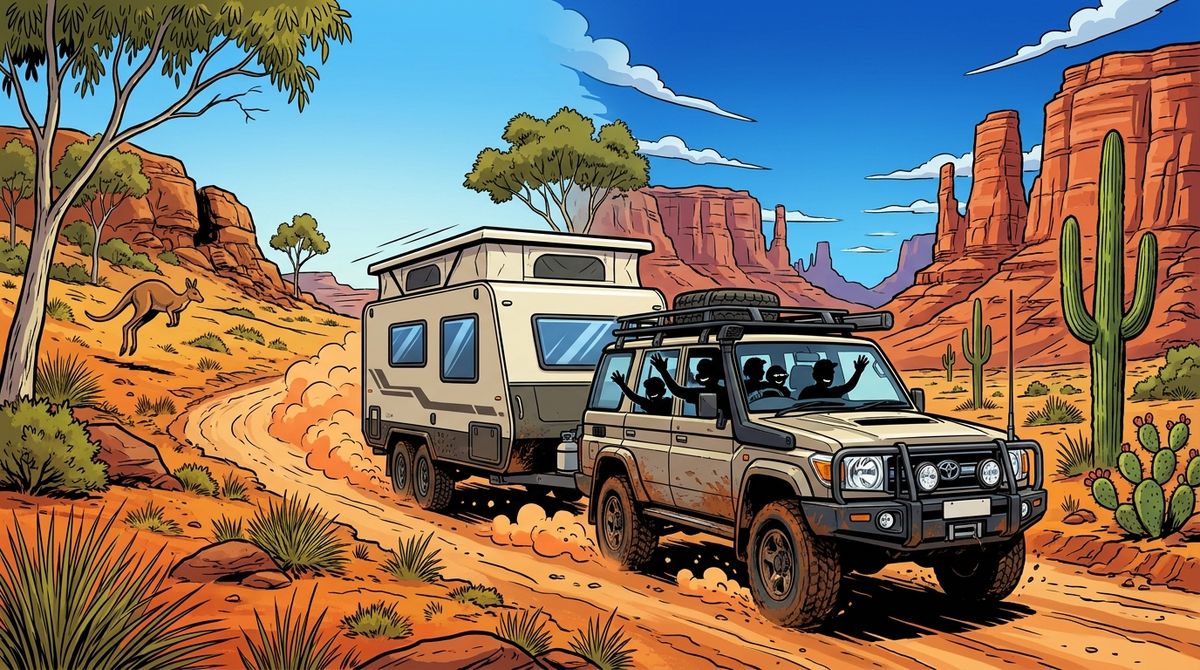
At the end of September, a quiet piece of news slipped out of the Australian caravan industry that says a lot about where it's headed.
Dream Haven RV — the Melbourne-based manufacturer whose vans are built in Australia by Crusader, one of the country's most awarded RV builders — confirmed its Gladiator Familia is heading to the United States. The first US-specification units are already in production, with the compact family off-roader set to debut at Overland East Expo in Virginia from 23–25 October, before appearing at SEMA in Las Vegas in early November [1][2].
Usually the flow runs the other way. American RV brands dominate global headlines, and Australian caravanners import ideas — and plenty of product — from the US overlanding scene. An Aussie-built bunk van going the other direction, into the heart of the American overland market, is a genuine first-of-its-kind moment for local manufacturing.
Summer Salvato, Dream Haven's head of special projects and US development, says the interest is already there. "I've spoken with consumers, dealers and prospective dealers across the country, and they've all been very interested in our compact overlanding bunk van, the Familia," she said. "The Familia provides durability, comfort, style and, most importantly, confidence to our already established Australian base of adventurers." [1]
For Australian families, the launch matters for a simpler reason: the compact family off-road caravan — once a compromise category — has become one of the most hotly engineered segments in the local market. The Familia is a useful lens on why.
What the Gladiator Familia Actually Is
The headline pitch is capability in a small footprint. The Familia has a 17-foot body and a 23-foot overall towable length — substantially shorter than the 21–23 foot family vans that anchor most Australian bunk ranges — while packing a level of off-grid hardware that until recently was reserved for much larger rigs [1][2].
Key specifications:
- Sleeping: 6-foot bunk beds (large enough for adults), an optional triple-bunk configuration, and a convertible twin-to-queen bed up front. The lower bunk can double as a dedicated sleeping space for the family dog. Living: Separate dual bench seating and dining, internal wet bath, portable induction cooktop, Smart TV and extensive interior and exterior storage. Off-grid power: 690W solar, a 460Ah heated lithium battery, a 3kW inverter and DC-to-DC charging as standard. Water: Dual heated freshwater tanks and a heated grey water tank — a cold-weather touch most Australian vans skip. Underneath: Off-road airbag suspension, machine-welded galvanised Australian steel chassis, full-size spare and external hot and cold shower [1][2].
The construction is worth noting too. The floor and walls use fully composite XPS-insulated fibreglass panels, and the front wall, roof and rear wall are each manufactured as single-piece components — no joins in the areas where water and dust usually find their way in [2].
Why Compact Family Vans Are Having a Moment
The Familia's timing isn't accidental. Australian caravanning has been shifting under manufacturers' feet for several years, and the compact end of the family market is where the pressure shows most clearly.
According to the Caravan Industry Association of Australia's State of the Industry 2026 report, the country now has roughly 937,000 registered RVs — up 4% year-on-year — with Australians taking 17.3 million caravan and camping trips in 2025 worth $12.6 billion in spending [3]. But the shape of those trips has changed:
- Trips are shorter. Average trip length has fallen to 3.4 nights, with travellers staying closer to home [3]. Buyers are more value-conscious. Consumers are taking longer to move from enquiry to purchase, and weighing up used and lower-priced options more carefully [3]. Families want one van that does everything. School-run-adjacent weekends, a couple of weeks at Christmas, and the occasional serious off-grid run — without owning a 23-foot, 3.5-tonne land barge for the 40 weekends a year it sits in the driveway.
A well-sorted compact bunk van threads that needle. It's towable by the dual-cab utes most Australian families already own, fits into national park campsites that big tandem-axle vans can't, and — as the Familia demonstrates — can now carry enough battery, solar and water to stay off powered sites for days at a stretch. The US market noticed the same formula, which is precisely why an American distributor network wanted it.
What Australian Buyers Should Take From the US Launch
A US launch doesn't change the van on the lot in Melbourne — Australian Familias were already available here, and the local spec is the one local buyers get. But it does tell you three useful things.
1. Local engineering is being validated offshore. Australian caravans have long had a reputation for ruggedness born of corrugated roads and harsh sun. Having a US-market distributor stake money on that reputation is a stronger vote of confidence than any advertising.
2. Compact doesn't mean cut-down anymore. A 460Ah lithium bank and 690W of solar in a 17-foot van would have been unthinkable five years ago. If you're shopping family vans, use the Familia as a benchmark for what "standard" off-grid equipment should look like in 2026 — and ask harder questions of any van that charges extra for it.
3. Resale and support networks matter more than launch headlines. If you're comparing bunk vans, check the dealer and service network in your state, the structural warranty length, and whether the builder has a track record — Dream Haven's backing by Crusader's 20-plus years of manufacturing is the kind of detail that outlasts a launch story [1].
The Bottom Line
The Australian caravan industry's bad news has made plenty of headlines this year. The Familia's US debut is the other side of that story: local design, local steel, local manufacturing, and a product good enough that the world's biggest RV market wants in.
For families shopping the compact end of the market, the lesson is straightforward — demand more from a small van. Bunk beds, a proper wet bath and genuine off-grid autonomy are no longer big-van exclusives.
And if a weekend on the water sounds better than a weekend on the corrugated stuff, Cat Cruisers builds Australian-made amphibious vessels — the same "one vehicle, land and sea" logic, taken literally. Details at catcruisers.com.au.
Sources
1. RVBusiness, "Dream Haven RV Launches the Gladiator Familia for Families", 30 September 2026. https://rvbusiness.com/dream-haven-rv-launches-the-gladiator-familia-for-families/
2. RV PRO, "Dream Haven RV Launches Gladiator Familia", October 2026. https://rv-pro.com/news/dream-haven-rv-launches-gladiator-familia/
3. Max Taylor, GoRV, "State of the Australian Caravan Industry", 13 July 2026. https://gorv.com.au/state-of-the-australian-caravan-industry/