
Australia bought an EV every 100 seconds in 2026 — but utes and trucks are still stuck in neutral
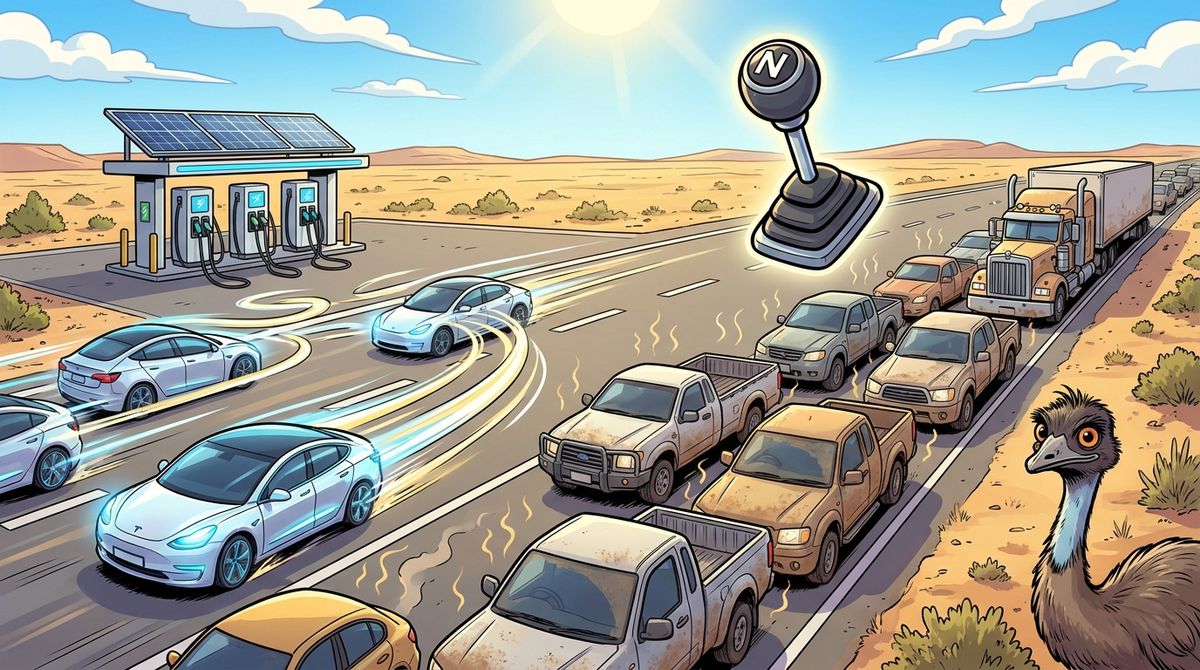
Australians bought 157,957 electric vehicles in the first six months of 2026. Spread across the working year, that's roughly one EV driving out of a showroom every 100 seconds — a 117 per cent jump on the same period last year, and the strongest six months on record for the Australian market.[1]
The Electric Vehicle Council's tenth annual State of EVs report, released on 30 September, lands the headline numbers: EVs took 25.8 per cent of all new-car sales in H1 2026 (up from 12.1 per cent a year earlier), the national fleet passed 500,000 vehicles in March and reached 612,000 by June, and petrol and diesel sales fell 14 per cent over the same window.[1][2]
For anyone watching Australia's transition from the fleet, mining or caravan side of the fence, though, the more interesting figure is buried deeper in the report: electric trucks and vans still represent less than 1 per cent of their respective markets.[1]
The passenger boom is real
The raw data behind the boom is worth spelling out:
- 157,957 EVs sold in H1 2026 — 103,716 battery-electric and 54,241 plug-in hybrid, up 117 per cent year-on-year[1] 25.8 per cent market share — one in four new vehicles sold was electric, up from 12.1 per cent in H1 2025[1] 612,000 EVs in the national fleet as of June 2026, after passing the half-million mark in March[1] 196 models available — 125 BEVs and 71 PHEVs, up from 153 in 2025[1] 4,268 public charging locations and 11,602 public connectors, up 235 per cent and 175 per cent respectively on June 2025[1]
EVC chief executive Julie Delvecchio framed the shift as a cost-of-living story as much as an environmental one. "The pace of EV sales growth reflects a powerful combination of greater vehicle availability, improved affordability and a growing awareness that EVs provide one of the best ways to cut the cost of living right now," she said.[1]
Delvecchio put the running-cost saving at around $3,000 a year, with petrol averaging 237.5 cents a litre in the week to 27 September — and noted that most EV drivers cut annual fuel bills by more than 60 per cent, according to the EVC's March ownership survey.[2][1]
The NVES question
The EVC is unambiguous about the policy driver: the National Vehicle Efficiency Standard, which began penalising high-emission new vehicles in 2025 and credits efficient ones. "The key to this growth is the National Vehicle Efficiency Standard (NVES) which has driven choice in EVs and affordability across all vehicle segments," the council said, calling on the government to begin the legislative review of NVES before the end of this year and to extend it beyond 2029.[1]
That call carries political weight. The Coalition has previously vowed to scrap the standard, and this year's report arrives while the FBT exemption for EVs is being wound back from April 2027 under the 2026–27 Budget.[2] The council argues the NVES review will show the standard's role in cutting household costs — and that letting it lapse would put the supply of affordable models at risk.
The EVC also says this week's interest rate rise to 4.6 per cent won't stall demand: head of legal, policy and advocacy Aman Gaur noted EV sales grew through six previous rate rises, and that the roughly 500,000 battery-electric cars now on Australian roads need to grow tenfold to meet the 2035 emissions target.[2]
The gap the headline misses
Here's the uncomfortable arithmetic for fleet operators, miners and anyone towing a caravan: passenger cars are electrifying at pace, but the vehicles Australia actually works with are not.
The report finds electric truck and van sales continue to sit below 1 per cent of their markets.[1] That matters because:
- Light commercial vehicles are the workhorse segment. Utes and vans dominate trades, mining support fleets, agriculture and touring — precisely the use cases where fuel costs bite hardest and where range anxiety is most often cited. Supply, not demand, is the binding constraint. The NVES has pushed global brands to send passenger EVs to Australia; there is still no mass-market battery-electric dual-cab ute on sale here, and the pipeline (factory utes included) runs to 2027–2028 at the earliest. Every year of delay compounds fleet emissions. A diesel ute kept in service for a decade locks in its fuel burn. Fleets under ESG pressure can't wait for a factory model that hasn't landed.
This is where the conversion sector has carved out a genuine role. With no factory electric LandCruiser or HiLux available, local converters have been filling the gap for mining and government fleets — a point underlined this year by the contrast between BHP's stalled electric haul-truck ambitions and Fortescue's push to put battery-electric trucks and excavators into Pilbara service before the end of the decade.[3]
There is also a growing second-hand dimension. As Australia's fleet of 612,000 EVs ages, battery health and end-of-life pathways for both passenger EVs and converted vehicles become commercially relevant — both for resale values and for the mining and fleet sectors weighing conversion against replacement. The State of EVs report doesn't cover that layer in depth, but the sheer volume of vehicles now on the road makes it a question the industry will have to answer in the next few years.
What this means if you run a fleet — or tow a van
For fleet managers and business owners, the report reads two ways. The good news: the passenger-EV market now offers 196 models, charging infrastructure is scaling fast, and total cost of ownership for light EVs is well understood. The harder news: if your operation depends on utes, trucks or towing, the new-car market still offers very little, and waiting for it is itself a decision.
Practical steps worth weighing now:
- Audit your actual duty cycles. Most fleet utes travel well under 200km a day. For those vehicles, a converted or electric light commercial can already pencil out against diesel — especially at current fuel prices. Watch the NVES review. Its outcome will shape which commercial models get sent to Australia after 2029. Submissions and industry feedback during the review are where fleet buyers have a voice. Factor in the FBT phase-down. Leases signed before April 2027 lock in the full exemption for the lease term — relevant for passenger and light-commercial EVs already on the market. For towing and touring: the boom in public connectors (now 11,602 nationwide) is steadily shrinking the practical gaps on popular routes, but remote travel still rewards self-sufficiency — high-capacity battery systems and solar on caravans and campers are doing the heavy lifting beyond the plug network.
The Australian EV transition has crossed into the mainstream for passenger cars. The next test — for policy, for manufacturers and for the local conversion industry — is whether the working half of the fleet gets to follow.
Australian EV Group tracks the conversion, mining electrification and electric RV sectors nationally. For fleet operators weighing an electric transition, the report's charging and model data is a useful starting point for a duty-cycle assessment.
Sources
1. pv magazine Australia (EVC media release), "State of EVs 2026: an EV bought every 100 seconds as car choice, charging and innovation accelerate", 30 September 2026. https://www.pv-magazine-australia.com/press-releases/state-of-evs-2026-an-ev-bought-every-100-seconds-as-car-choice-charging-and-innovation-accelerate/
2. TheAutoExec, "Australians buy an EV every 100 seconds — but the EV Council says sales must grow tenfold to hit 2035 targets", 1 October 2026. https://theautoexec.com/theautoexec/2026/10/01/australians-buy-an-every-100-seconds-but-the-ev-council-says-sales-must-grow-tenfold-to-hit-2035-targets
3. The Driven, "The simple tricks Fortescue is using to convert its fleet of giant diesel haul trucks to full battery electric", 25 September 2026. https://thedriven.io/2026/09/25/the-simple-tricks-fortescue-is-using-to-convert-its-fleet-of-giant-diesel-haul-trucks-to-full-battery-electric/