
Australian EVS enters voluntary administration: what it means for Australia's EV conversion industry
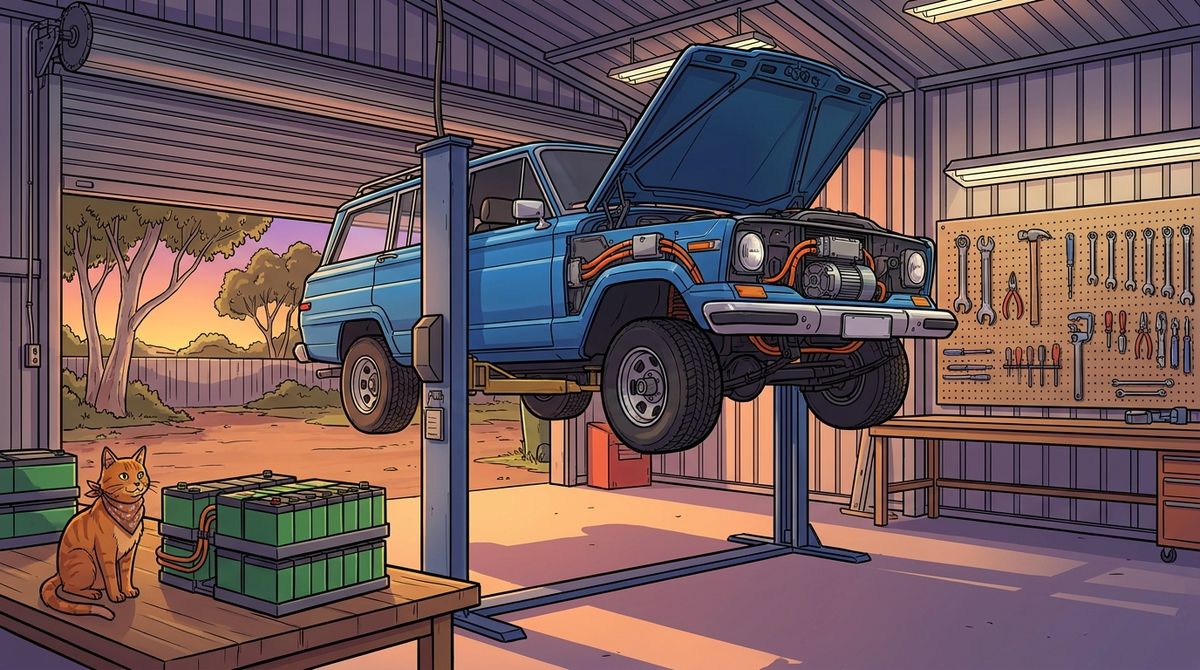
Seven months after a federal agency published a glowing case study on the Hunter Valley's most prominent electric vehicle conversion business, the company has called in administrators.
Australian Electric Vehicle Specialists Pty Ltd, which trades as Australian EVS, entered voluntary administration on 12 October. Administrators James Alexander Shaw and Jeffrey Allan Shute of Newcastle firm Shaw Gidley were appointed by the company, and the first creditors' meeting is scheduled for 12pm on Wednesday 22 October at Charlestown, with proofs of debt and proxies due the day before.[1]
The timing has stunned many in the sector. In March this year the Net Zero Economy Authority (NZEA) published a case study reporting that Australian EVS had grown in four years to 16 staff and doubled its workshop space, converting everything from MGBs, Jaguar E-Types and classic Land Rovers to brand-new Toyota LandCruiser 79 Series utes.[1] Ten months before calling in administrators, the company raised $325,000 from 172 retail investors through the OnMarket crowdfunding platform.[1]
What Australian EVS built
Founded in 2021 by Edwin Higginson and James Bourne, Australian EVS sat at the centre of Australia's small but technically credible conversion industry. Its work spanned four streams:[1]
- Full vehicle conversions, from classic cars to new LandCruisers and Nissan Patrols e-Kits, the company's drop-in conversion kit line for vehicles that cannot be bought new in electric form e-Pods, mobile battery storage and EV-charging trailers built for events, construction sites, agriculture and emergency response Fleet consulting, helping councils, utilities and mining businesses plan electrification
The company's engineering chops were genuine. The NZEA case study noted its five engineers had competed in Formula Student, and its showcase build — a 2025 LandCruiser 79 Series converted to electric drive — was claimed to deliver three times the power of the V8 diesel with a quarter of the running costs.[1] It won Outstanding Start-Up Business of the Year at the 2025 Hunter Manufacturing Awards.[1]
Australian EVS was also pushing into heavy vehicles. In March 2026, director Edwin Higginson told ABC coverage carried by BusNews the company was converting a 1978 Leyland double-decker — a former Byron Bay community bus with a psychedelic paint scheme — into a battery-electric motorhome with 280kWh of battery, rooftop solar and more power than its original engine, worked through with the National Heavy Vehicle Regulator (NHVR) for compliance.[2]
More significantly for the sector, the company had completed a business case for an Australian public transport authority on converting a fleet of 100 BusTech Group XDI diesel buses. The finding: repowering buses aged eight to 20 years was cheaper than continuing to run diesel over their remaining 10-year asset life.[2]
The numbers behind the collapse
The administrators' report will set out exactly what went wrong, but the public record already tells a sobering story about the economics of running a conversion business in Australia.
According to the OnMarket offer documents archived while the crowdfunding raise was open in late 2025, Australian EVS reported:[1]
- Revenue of $490,000 in the first quarter of FY2026 (July to September 2025), with positive EBIT A budget of $1.5 million in revenue for FY2026 Eight months of forward work "already confirmed" More than $700,000 spent on research and development Government Industry Growth Program and R&D grants, plus a recently awarded Australian Made certification
On those figures the business was growing, not shrinking. Yet within a year of the raise, the company's cash position had deteriorated badly enough for voluntary administration. Conversion workshops are working-capital hungry: customer deposits fund long build cycles, compliance engineering is expensive, and a small number of delayed projects or refund claims can stress a thin balance sheet quickly.
The second failure this year
Australian EVS is not the only conversion business to hit the wall in 2026. In March, the parent company of Queensland importer and converter AUSEV — best known for converting Ford F-150 Lightnings to right-hand drive in Brendale — was placed into receivership, with about 100 staff affected. The receivers and the company blamed Ford's decision to axe the F-150 Lightning, which destroyed the forward supply pipeline despite what were described as strong sales.[3]
Two failures in seven months does not make a trend on its own, but together they underline how exposed Australian converters are to forces outside their control: OEM product decisions overseas, a compliance and registration framework that adds cost and time to every build, and a policy landscape that subsidises new EV purchases while offering nothing comparable for conversions that keep existing vehicles on the road.
What happens now
Voluntary administration is not liquidation. The administrators take control, investigate the company's position and report to creditors, who then decide the future. A second meeting, normally within about five weeks of appointment, will decide whether the company executes a deed of company arrangement, returns to its directors, or is wound up.[1]
For the various groups with skin in the game:
- Customers with deposits or work in progress — your claim runs through the administration. Lodge a proof of debt with Shaw Gidley before the 21 October deadline, and contact the administrators directly about retrieving a vehicle or parts. Converted vehicle owners — administration does not void existing builds, but warranty and ongoing support now depend on the administrators' decisions and whether the business, its assets or its trademark are sold. Keep full documentation of your conversion. Crowdfunding investors — as shareholders, the 172 OnMarket investors rank behind all creditors and are likely to recover little or nothing in a wind-up.
What it means for the conversion sector
The uncomfortable question the sector now faces: if a business with federal case-study recognition, award wins, confirmed forward work and positive EBIT cannot survive, what would it take for conversion to be a viable industry in Australia?
Practitioners point to structural headwinds that have not changed:
- Compliance cost. Every conversion needs individual engineering sign-off and state-by-state registration wrangling, with no harmonised national pathway for converted vehicles. No demand-side support. Buyers of new EVs can access fringe benefits tax exemptions, stamp duty concessions and state incentives; buyers of conversions get nothing. Fleet procurement gaps. The BusTech business case showed diesel repowering wins on lifecycle cost, yet no Australian fleet program currently funds conversions at scale.
There is also a workforce dimension. Conversion shops like Australian EVS train exactly the kind of cross-disciplinary engineers — high-voltage battery systems, drivetrain integration, controls, compliance testing — that mining electrification and heavy-vehicle programs across the country are struggling to hire. Whether those 16 staff land in other electrification roles or leave the field will be a small but real signal for the industry's capacity.
For fleet operators, the episode does not invalidate the conversion business case. If anything, the BusTech feasibility work makes the economics clearer: where a vehicle has years of structural life left, repowering can beat diesel on total cost. The risk sits with the supplier, not the engineering. That shifts the burden onto procurement — spread builds across milestones, verify compliance documentation before final payment, and ask builders directly how they would honour warranty obligations if ownership changed.
Supporters of the sector argue the case for conversion is stronger than ever — diesel supply shocks, ageing fleets and extended wait times for new electric trucks and buses all favour repowering existing vehicles. But policy has not caught up, and the talent and IP concentrated in shops like Australian EVS is fragile. What happens to the e-Kit designs, the e-Pod trailers and the engineers who built the LandCruiser conversion is now an open question that creditors, and possibly a buyer, will decide.
The Australian EV Group has long argued the conversion industry needs the same regulatory certainty handed to new EV imports; stories like this one are why. For anyone weighing a conversion, the lesson is to check your builder's financial footing, get compliance paperwork in writing, and structure payments to protect yourself if the workshop does not survive the build.
Sources
1. The Open Register, "Australian EVS in Administration: Investors and Creditors Investigations Analysis", 14 October 2026. https://www.theopenregister.com/p/deep-dive-2026-10-14-australian-evs-administration-electric-vehicle-specialists
2. BusNews (carrying ABC coverage), "EV specialists begin converting diesel buses to electric in Australia", 2026. https://www.busnews.com.au/ev-specialists-begin-converting-diesel-buses-to-electric-in-australia/
3. CarExpert, "Australian EV conversion firm collapses — Ford blamed", 2026. https://www.carexpert.com.au/car-news/australian-ev-conversion-firm-collapses-ford-blamed