
Australian Sailing Just Signed a Six-Year RIB Deal. Here's Why It Matters for Every Aussie Boater.
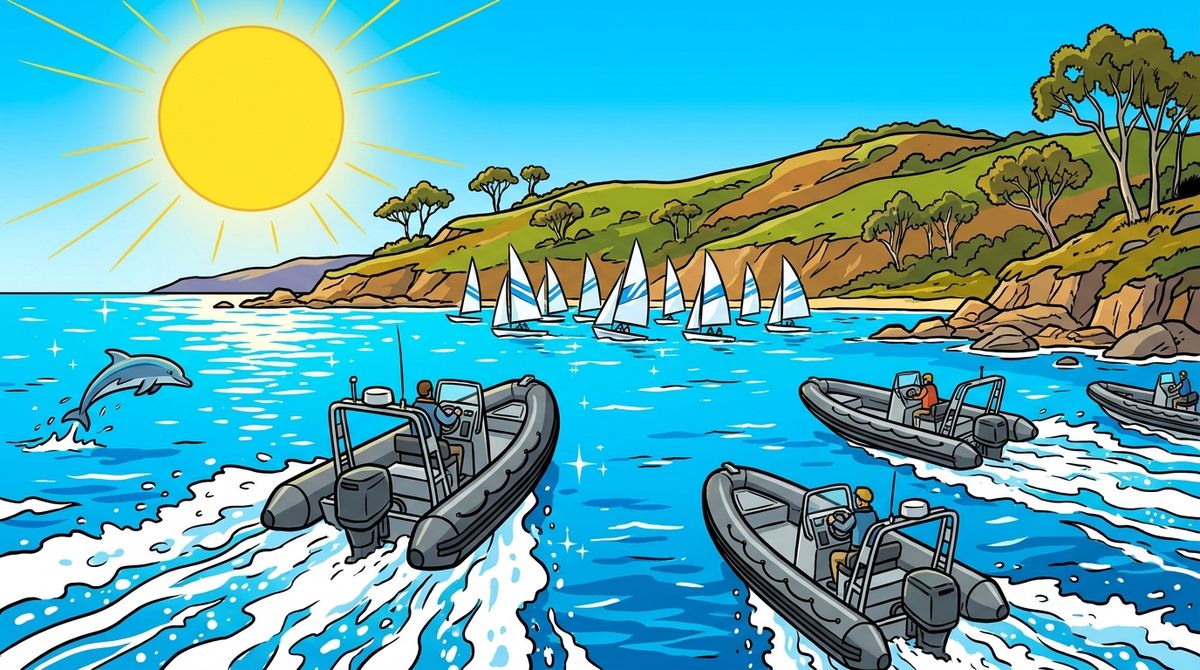
On 15 September 2026, a New Zealand boat builder most Australians have never heard of locked in one of the most significant equipment deals in Australian sailing.
Southern Pacific Boats — a Kumeu-based manufacturer that has been building inflatable vessels since 1988 — signed a six-year global partnership with Australian Sailing, becoming the official RIB supplier to Australian Sailing and the Australian Sailing Team (AST) through to the Brisbane 2032 Olympics [1].
The deal means Southern Pacific's PerformR and SeekR models will form the backbone of the AST coaching fleet, supporting Australia's Olympic-class sailors through the build-up to Los Angeles 2028 and a home Games in Brisbane. AST Technical Director Michael Blackburn — a Sydney 2000 Laser bronze medallist who has coached sailors to four Olympic gold medals — said the boats give coaches "a dependable platform to work from across a range of conditions" [1].
Six years is a long commitment in any sport. In Olympic sailing, where equipment contracts can make or break a training cycle, it's a statement of intent. Australia is backing its sailors with serious hardware, and the flow-on reaches well beyond the high-performance squad.
What Even Is a RIB?
RIB stands for rigid inflatable boat. The name describes the construction exactly: a solid, shaped hull (the rigid part) wrapped in an inflatable collar or tube (the inflatable part). If you've watched a sailing regatta, a surf lifesaving event, or a navy exercise, you've seen one. They're the workhorses buzzing around the edges of almost every organised on-water activity in the country.
The design is clever because the two halves solve different problems:
- The rigid hull cuts through chop, tracks properly at speed, and gives you a stable platform to work from. The inflatable collar adds buoyancy that would be impossible to achieve with hull volume alone, acts as a giant fender alongside other boats, and keeps the vessel afloat even if the hull is swamped.
The result is a boat that's lighter, more stable, and more forgiving than a conventional tinny of the same length — which is exactly why coaches, race officials, and safety crews have quietly made RIBs the default choice on Australian waterways.
Within the category, three broad types cover almost everything you'll see on the water:
- Tenders and yacht dinghies — small, light, often towed behind a larger vessel. Southern Pacific has been building these since 1988. Centre-console and jockey-seat RIBs — the open-deck workhorses used for coaching, safety, diving and fishing. This is the territory of the PerformR and SeekR models entering the AST fleet [1]. Large cabin and specialist RIBs — coastguard, military and commercial craft up to and beyond 14 metres, where the format's buoyancy and seakeeping really show their worth [1].
Why This Deal Is Bigger Than One Boat Brand
Strip back the press release and the Southern Pacific partnership is really about three things.
1. A locked-in equipment pathway to 2032
The coaching and support boat is the most overlooked piece of hardware in any sailing program. Athletes get the headlines; the RIBs that tow them out, drop them at the start line, recover them after capsizes and follow them through every training session do the invisible work. A bad support boat costs training hours. A good one quietly multiplies them.
Olympic programmes hate uncertainty. Sailing Australia's coaches will now train on the same RIB platform for two full Olympic cycles — LA28 and Brisbane 2032 — rather than re-learning new support boats every four years. That's the same logic any serious boat buyer uses: pick a platform, learn it properly, and get years of reliable service out of it.
2. The flow-on to grassroots clubs
This is the part most coverage will skip, and the part that matters most to everyday boaters. Under the partnership, Australian Sailing affiliated clubs get exclusive pricing on three Southern Pacific models — the Vortex, SeekR and PerformR — for race management, coaching, safety and on-water support [2]. The boats are built to order, so lead times apply, but the pricing window is there for clubs from local dinghy fleets up.
It follows a similar recent tie-up between Australian Sailing and Mercury Marine, which gives affiliated clubs discounted outboard purchases through participating dealers [2]. Two equipment partnerships in quick succession is a deliberate strategy: lift the on-water capability of grassroots clubs, and the entire sport gets stronger underneath the elite layer.
If you sail, paddle, or fish anywhere near a club, this is worth paying attention to. Stronger club fleets mean more safety boats on the water, better-run events, and cheaper pathways for juniors learning the sport — the exact pipeline that keeps participation numbers healthy between Olympic cycles. Sailing has always had a participation problem to manage; deals like this attack it at the infrastructure level rather than with marketing slogans.
3. Olympic investment is starting to show up in the marine industry
Brisbane 2032 is still six years away, but the money is moving now. Equipment contracts, club support programs and coaching infrastructure all get built in the years before a home Games, not during it. For an industry that the Boating Industry Association sized at $10.5 billion in national turnover for 2025-26 — holding steady on the previous record year — an Olympic cycle on home water is genuine wind in the sails [3].
The same BIA State of the Industry data report card puts some useful scale around all of this [3]:
- 950,000+ registered boats in Australia, plus a large fleet of non-motorised craft that doesn't require registration 2.5 million people hold a licence to drive a powerboat — roughly one in ten Australians 23,500 people directly employed in the boating industry, plus 11,500 in contractor roles, supporting more than 2,000 businesses 85% of boats are under 6 metres, and 60% of boating trips run up to four hours — short, local, accessible outings
That last point is the quiet headline. Most Australian boating isn't offshore passages or superyachts. It's a morning on the Broadwater, an afternoon fishing a bay, a safety boat supporting a junior regatta. RIBs sit squarely in that reality — which is why a sensible RIB procurement strategy matters at every level of the sport, from Olympic coaches down to the volunteer running the safety boat at a Sunday club race.
The picture that emerges is an industry in solid shape rather than spectacular shape: turnover holding at record levels, registrations stable, and employment spread across more than 2,000 mostly small businesses [3]. That steadiness is worth more to a buyer than a boom headline — it means the dealer, the service agent, and the parts supplier you're relying on are operating in a sustainable market, not a sugar rush.
What to Look for If You're Buying a RIB
Coaches aren't the only people who've figured out RIBs. Trailer boaters, divers, anglers and families wanting a stable platform have all drifted toward the format, and the used market is full of options at every price. If you're shopping, the questions that actually matter:
- Tube material: Hypalon or PVC? Hypalon (a synthetic rubber) resists UV, fuel and abrasion far better than PVC and is the standard on commercial and military-grade boats — including the 14-metre tubes Southern Pacific builds for coastguard and military contracts [1]. PVC is cheaper and fine for light recreational use kept under cover. Hull design, not just tube diameter. A deep-V hull handles chop; a flat-bottomed RIB is a barge with a collar. Match the hull to your typical water. Payload and tow rating. RIBs carry more than they look like they should, but every boat has a limit. Check the compliance plate, not the brochure. Outboard pairing. RIBs are sensitive to being underpowered. The Australian Sailing club deal bundles discounted Mercury outboards for a reason — the boat and motor need to be specified together [2]. Trailer and storage reality. Most RIBs live on a trailer between uses, so check overall trailer weight against your tow vehicle rating, whether the tubes can be left inflated under a cover (most quality Hypalon tubes can), and how the boat behaves at the ramp in a crosswind — the high bow collar catches wind differently to a tinny. Who services it locally? This is where Australian and New Zealand manufacturing earns its premium. Parts, tubes, and people who know the boat exist in the same timezone as your weekend. Southern Pacific has built to order since 1988 with a board that includes former America's Cup skipper Dean Barker [1] — that kind of institutional knowledge matters when something needs repair. Registration and state rules. RIBs are registered like any other powerboat in each state. Check your state authority's requirements before you buy, not after.
The Bottom Line
A Kiwi RIB builder landing a six-year deal with Australian Sailing won't change what most boaters do this weekend. But it's a useful signal of where the sport is heading: more structured club support, more investment flowing into on-water programs ahead of Brisbane 2032, and continued preference for versatile, trailerable, workhorse platforms over single-purpose hardware.
Whether your on-water time is coaching a regatta, fishing a bay, or taking the family out on the Broadwater, the logic is identical — choose the platform that does the most jobs well, buy from people who'll still answer the phone in five years, and let the Olympics do what home Games always do: put more Australians on the water.
Cat Cruisers handcrafts Australian-made amphibious vessels on the Gold Coast — proof that purpose-built Australian marine manufacturing still punches well above its weight.
Sources
1. GoBoating NZ, "Southern Pacific Boats named Australian Sailing RIB supplier", 15 September 2026. https://goboating.nz/articles/kiwi-rib-builder-southern-pacific-boats-named
2. AFTA, "2026 Boating Data Report Card released", 2026. https://afta.net.au/2026-boating-data-report-card-released
3. Boating New Zealand, "Kiwi RIBs to power Australian sailing's Olympic push", 15 September 2026. https://www.boatingnz.co.nz/2026/09/kiwi-ribs-to-power-australian-sailings-olympic-push
4. Marine Business News, "2026 Boating Data Report Card released", 6 August 2026. https://marinebusinessnews.com.au/2026/08/2026-boating-data-report-card-released