
BYD puts vehicle-to-grid in Australia's best-selling EV — and V2G stops being a curiosity
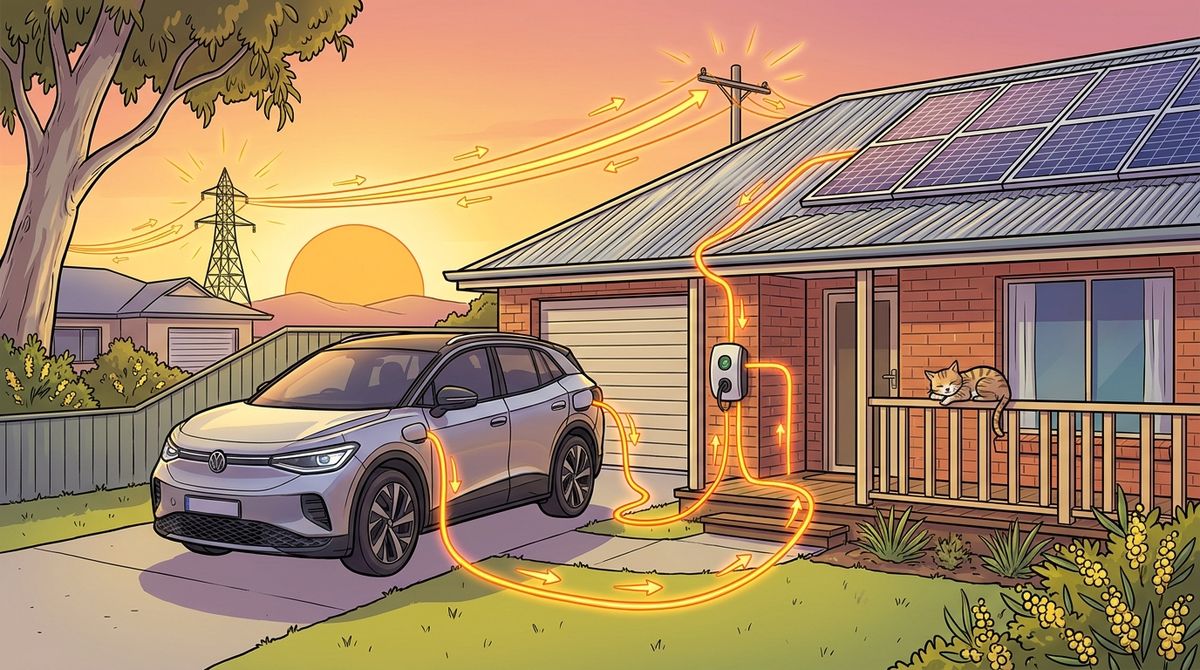
For the past two years, vehicle-to-grid (V2G) in Australia has been a technology you could only access if you happened to own one specific model of one specific brand and lived in the right postcodes for a trial. That changed this week.
Amber Electric and BYD Australia announced they have expanded their V2G partnership to include the Sealion 7 — BYD's best-selling electric vehicle in Australia, with more than 30,000 sold since its local launch in February 2025. The Sealion 7 joins the Atto 3 in Amber's program, which is being scaled to 1,000 Australian households under $13.6 million in funding from the Australian Renewable Energy Agency (ARENA). More than 50 V2G sites are already operating, and Amber says over 8,000 people are on its waiting list.[1]
The reason this matters beyond BYD owners is what it signals. V2G has been stuck in a loop: drivers worried it would void their battery warranty, manufacturers wouldn't commit to warranty coverage, and energy retailers couldn't build a business case on a handful of compatible cars. This announcement loosens all three knots at once.
What V2G actually does (and how it's different to V2L)
The terminology gets used loosely, so it's worth being precise:
- Vehicle-to-load (V2L) is the simpler capability. The car's battery powers appliances directly through an onboard outlet — fridges, tools, camp lighting. The Sealion 7 already has this as standard, at up to 3.6kW on BYD's Blade Battery.[1] Vehicle-to-grid (V2G) goes further. A bi-directional charger lets electricity flow from the car back into your home wiring or the electricity grid itself, controlled automatically in response to prices and demand.
With V2L, the car is a big powerboard. With V2G, the car becomes part of the electricity system — buying power when it's cheap and abundant, and selling it back when it's scarce and expensive.
Amber's platform automates those decisions. Participants charge when wholesale prices and emissions are lowest, then export stored energy when prices spike. According to trial figures reported when ARENA expanded the program in May, participants can save around $2,500 a year by combining smart charging with V2G exports; one South Australian customer reportedly earned $500 in a single day during the January 2026 heatwave when wholesale prices spiked.[2]
The funding and scale behind the program
The numbers give a sense of how seriously the federal government is taking this:
- Total ARENA funding: $16.8 million, after the original $3.2 million pilot[2] V2G households: scaling from 50 to 1,000[2] Smart charging households: scaling from 950 to 2,000[2] Announced: 29 May 2026, by federal Energy Minister Chris Bowen, at a pilot participant's home in Lidcombe, Western Sydney[2]
The original pilot was deliberately small — designed to test real-world performance, battery degradation and consumer behaviour before any larger rollout. The fact that ARENA came back with more than four times the original funding, and that a manufacturer the size of BYD has now put its highest-volume model into the program, suggests the trial data has been encouraging.
Why the battery warranty question was the real blocker
The most consequential part of this week's announcement is easy to overlook: BYD has confirmed that Sealion 7 owners participating in Amber's program receive battery coverage under the company's existing warranty arrangements, as already applies to Atto 3 participants.[1]
Battery longevity has been the single biggest hesitation around V2G. An EV battery is the most expensive component in the car, and the idea of deliberately cycling it to serve the grid — hundreds of extra charge-discharge cycles over a vehicle's life — made both owners and fleet managers nervous. Manufacturer-backed warranty coverage doesn't eliminate that concern, but it transfers the risk to the party best placed to assess it.
Amber Electric Head of V2G Clare Rainbow framed the expansion in straightforward terms: "It means a much bigger group of Australians can access V2G and start earning money from a car that would otherwise spend most of its time parked."[1] BYD Chief Product Officer Sajid Hasan added that the Atto 3's involvement "has shown us the value this can unlock for customers".[1]
For fleet operators, this is the development to watch. Most fleet vehicles sit stationary overnight, which is precisely when grid demand peaks and prices are highest. A depot full of V2G-capable vehicles is, in effect, a distributed battery that can shave peak demand, support the building during high-price periods, and potentially generate revenue from assets that would otherwise be idle.[1]
The catch, stated plainly
It's worth being clear about what this announcement isn't. V2G in Australia is still not a general-market product:
- Compatibility is brand-limited. If you drive something other than a BYD, this program isn't open to you yet. It's tied to one energy retailer. Amber runs the platform, the automation and the tariff that makes the economics work. The trial is capped at 1,000 V2G households. Even with 30,000-plus Sealion 7s already on the road, the vast majority of owners won't get a spot in this round.
None of that undermines the announcement — it contextualises it. Every energy technology that eventually became boring started exactly here: a funded trial, a manufacturer warranty commitment, a waiting list longer than the participant count. The direction is also consistent with how ARENA has framed the project from the outset: testing real-world hardware performance and consumer behaviour so that regulation and wider market design can follow with evidence rather than guesswork.[3]
What this means if you're an EV owner, buyer or builder
If you already own a compatible EV: V2G is moving from "early adopter experiment" to "available product". Amber participants can also buy eligible BYD models at a six per cent discount off base RRP, including GST — Atto 3 Evo Dynamic and Premium, plus Sealion 7 Premium and Performance variants.[1] With an 8,000-person waiting list, expect a queue.
If you're buying an EV in the next year or two: bi-directional capability is worth adding to your comparison criteria, alongside range and charging speed. Even if you never join a V2G program, the same hardware underpins V2L — which is increasingly useful in its own right.
If you run vehicles in remote, off-grid or touring settings: this is the quiet part of the story. The same Blade Battery that can export to the grid can run a campsite — fridge, lighting, induction cooking — without a generator. As V2L-capable EVs become common tow and support vehicles, the question for caravan and camper setups shifts from "how big is your battery bank?" to "can your tow vehicle top it up?" That crossover between vehicle electrification and off-grid power is exactly the space worth watching, and it's one the Australian EV Group works in daily, from conversions to camper power systems.
If you're a fleet manager: the business case for EVs keeps changing shape. Purchase price, running costs, and now energy participation — a vehicle that earns money while parked changes the total-cost-of-ownership calculation in a way spreadsheets from two years ago didn't account for. Worth revisiting before your next replacement cycle.
The bigger picture is that Australia's EV conversation is finally moving past "can an EV replace my petrol car?" into "what else can this battery do?" This week's announcement doesn't answer that question completely — V2G is still limited to specific brands, one energy retailer and a capped trial. But it takes the question out of the pilot-program margins and puts it in front of thirty thousand Sealion 7 owners. That's how adoption actually starts.
Sources
1. Fleet EV News Team, Fleet EV News, "BYD and Amber Expand V2G Partnership", 27 September 2026. https://fleetevnews.com.au/byd-and-amber-expand-v2g-partnership/
2. Business News Australia, "Amber Electric lands $13.6m ARENA boost to expand V2G trial to 1,000 Australian homes", 31 May 2026. https://www.businessnewsaustralia.com/articles/amber-electric-lands-13m-arena-boost-to-expand-v2g-trial-to-1000-australian-homes.html (replaces Zecar citation, which had no verifiable link; verified by red team 19 Oct 2026)
3. George Heynes, EV Infrastructure News, "Australia's largest residential vehicle-to-grid trial expands to 1,000 households", 31 May 2026. https://www.evinfrastructurenews.com/v2g/australia-s-largest-residential-vehicle-to-grid-trial-expands-to-1-000-households (link verified by red team 19 Oct 2026)