
EVX unveils Polecharger Rapid, an Australian-made kerbside DC fast charger
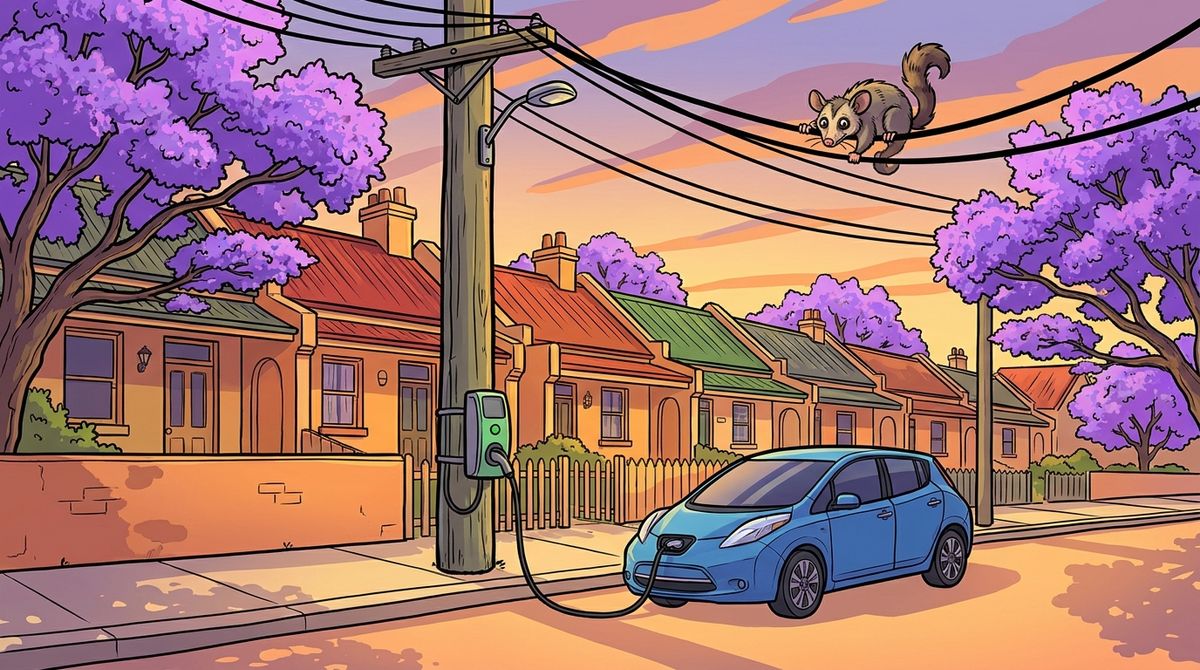
Australian EV charging manufacturer EVX has unveiled a new pole-mounted DC fast charger designed and built locally, in a move that pushes kerbside charging beyond slow AC top-ups and into genuine fast-charging territory for Australian streets.[1]
The Melbourne-based company announced Polecharger Rapid on 14 October 2026, describing it as a 40-50 kilowatt (kW) DC charger designed specifically for Australian electricity networks, local government requirements and public spaces. Initial deployments are slated for early 2027 across "strategically selected locations" in urban activity centres and regional and rural communities.[1]
Who is EVX?
EVX was founded in 2021 and has grown quickly by solving a very Australian problem: most of our urban charging demand sits in suburbs where homes were never built with off-street parking. The company's answer has been to hang chargers on the utility poles that already line those streets.
Its existing product, the Polecharger, is a 22 kW dual-charging AC unit that makes use of existing street infrastructure rather than requiring new footpath build-outs. The company now reports 518 chargers installed across 259 locations in New South Wales and Victoria.[1]
"We have already demonstrated that public EV charging infrastructure can be designed and manufactured locally and deployed at meaningful scale," EVX CEO Andrew Forster said at the unveiling. "Polecharger Rapid is the next step, taking that capability into DC charging and creating a product specifically for the places and conditions in which Australian councils, networks and communities need it to operate."[1]
What Polecharger Rapid is — and isn't
The headline figure is 40-50 kW of DC output. That sits well below the 150-350 kW you'd get at a highway ultra-rapid site, and EVX is not pretending otherwise. What it offers instead is a different trade-off:
- Speed: 40-50 kW DC adds roughly 150-250 km of range per hour of charging depending on the vehicle — a genuine top-up during a shopping trip or council stopover, not an overnight wait. Footprint: because it mounts on an existing power pole, it avoids the civil works, trenching and footpath space that make conventional DC fast-charging sites expensive and slow to approve in built-up areas. Placement: kerbside units can land directly where drivers actually park — the commuting suburbs, town main streets and regional centres where apartment dwellers and terrace-house owners have no driveway.
EVX says it is currently progressing detailed engineering, certification, manufacturing and deployment planning, with further technical specifications, manufacturing partnerships and initial deployment locations to be announced closer to commercial release.[1] The honest reading: this is an unveiling, not a product on the ground. The chargers don't exist on streets yet, and pricing has not been published.
The policy tailwind behind kerbside charging
Polecharger Rapid lands at a moment when kerbside charging has become federal policy, not just a municipal experiment. Several pieces are moving at once:
- The Commonwealth's $40 million Accelerating Electric Vehicle Charging Program — part of the Driving the Nation Fund — is funding kerbside charging in metropolitan areas and major regional centres, plus infrastructure in regional blackspots. Grants of $33.2 million are available over 2027-28 and 2028-29 to distribution network service providers (DNSPs) to identify and prepare network assets and install chargers at approved locations.[2] The Australian Energy Market Commission (AEMC) published a draft rule on 24 September 2026 to clear regulatory barriers for that program, including a "first right of refusal" for charge point operators to take up identified kerbside sites, with participating distributors required to act as a last-resort supplier where operators don't. Submissions on the draft determination close on 5 November 2026, with a final determination due by the end of 2026.[3][4] AEMC modelling for the draft rule weighed the program's emissions-reduction benefits against effects on consumer bills, competition between charging providers and access for people without off-street parking — including renters and apartment residents, the exact audience a pole-mounted kerbside charger serves.[4]
In short: the federal government is about to fund kerbside sites at scale, the market rules to enable them are being finalised, and EVX is positioning a locally manufactured product squarely at that gap.
Why local manufacture matters here
Charging hardware has largely been an import story in Australia. A locally designed and manufactured kerbside unit carries a few practical advantages that are easy to underestimate:
- Network compatibility: Australian distribution networks, street layouts and council footpath rules differ from the northern-hemisphere defaults baked into many imported units. A product engineered here starts with those constraints rather than adapting to them. Support and spares: a local manufacturer can service units without international logistics chains, which matters for hardware sitting on a street pole for a decade. Industrial policy: every charger installed is also a small data point in the case for Australian EV supply-chain manufacturing — a case the sector has been trying to build beyond assembly and imports.
The kerbside landscape EVX is walking into
Pole-mounted charging is no longer a novelty in Australia. Several operators now run kerbside or streetlight-based networks, and state governments have funded pilots in council areas with high proportions of apartments and terraces. What has been missing is speed: most kerbside units installed to date are AC chargers in the 7-22 kW range, which suits overnight or all-day parking but not a one-hour stop.
A 40-50 kW DC unit on the same pole changes the use case. It makes kerbside charging viable for:
- Commuters who park on-street and want a meaningful top-up during a workday or an evening out Trades and delivery drivers running electric vans who need opportunistic charge between jobs in built-up areas Visitors to town centres, libraries and shopping strips, where parking turnover is high and a slow AC unit would sit blocked all day
The trade-offs are real, too. Higher-powered DC equipment draws more from the local network, which is precisely why the AEMC rule change exists — to let distributors recover a set proportion of program-approved costs through regulated channels rather than leaving each council to negotiate bespoke connections. And kerbside DC pricing will matter: if session fees price out apartment-dwelling drivers, the infrastructure will underserve the exact people it was built for. Operators and councils will need to think carefully about per-kWh pricing, idle fees and access hours as these units roll out.
There is also a standardisation question worth tracking. Kerbside units in Australia have shipped with a mix of connector configurations and payment systems. A locally manufactured unit deployed at council scale is an opportunity to normalise contactless payment and CCS2 as the street-level default — something highway networks have largely settled but kerbside has not.
What this means for EV owners and buyers
For most drivers, Polecharger Rapid won't change anything this month. But it's worth watching for a few concrete reasons:
- If you can't charge at home — renters, apartment residents, terrace and townhouse owners — kerbside DC is the segment most likely to deliver usable fast charging within walking distance of where your car is already parked. When your council or DNSP announces kerbside sites under the Commonwealth program, the hardware being offered will increasingly be this class of product. 40-50 kW is a coffee-stop speed, not a road-trip speed. If you're planning touring or towing, treat these as destination chargers for town stops rather than a replacement for highway ultra-rapid sites. Expect roughly 150-250 km of range added per hour depending on your vehicle's charge curve and battery temperature. Regional drivers should watch the "rural and regional communities" commitment. EVX has flagged early-2027 deployments outside the capital cities. If your town is on a trunk route without a fast charger, a pole-mounted unit on the main street is a realistic near-term fix — and it's worth letting your council know demand exists. For fleets and small business, kerbside DC at depots and customer sites that lack dedicated charging infrastructure is an option that barely existed two years ago. The emergence of a locally supported product lowers the procurement risk.
The Australian EV Group has been following the local charging-manufacturing space closely as part of its broader coverage of Australian-made electrification, from conversions to off-grid touring setups. Stories like this one — an Australian company designing for Australian conditions — are exactly where the sector's next chapter gets written.
Watch for the deployment announcements: where Polecharger Rapid units land first, what they cost to use, and whether councils take them up under the Commonwealth program will tell us far more than any launch headline.
Sources
1. The Driven, "EVX unveils Australian-made pole-mounted DC fast charger for electric cars", 14 October 2026. https://thedriven.io/2026/10/14/evx-unveils-australian-made-pole-mounted-dc-fast-charger-for-electric-cars/
2. DCCEEW, "Accelerating Electric Vehicle Charging Program" (Driving the Nation Fund), 2026. https://www.dcceew.gov.au/energy/transport/driving-the-nation-fund/accelerating-electric-vehicle-charging-program
3. AEMC, "Facilitating EV charging infrastructure rollout under Commonwealth grants" (rule change page), 2026. https://www.aemc.gov.au/rule-changes/facilitating-ev-charging-infrastructure-rollout-under-commonwealth-grants
4. pv magazine Australia, "AEMC rule change accelerates federal government's $40 million EV charging infrastructure rollout", 2026. https://www.pv-magazine-australia.com/press-releases/aemc-rule-change-accelerates-federal-governments-40-million-ev-charging-infratructure-rollout