
Lifejacket Laws in Australia: What National Safe Boating Week 2026 Means for Your Summer
By Jason Rieck · Gold Coast · 12 October 2026
If you were on the water in Queensland this long weekend, you may have noticed more police on the waterways than usual. Sunshine Coast Water Police ran high-visibility patrols across the Mooloolah, Maroochy and Noosa River systems from Thursday through Monday, checking safety equipment, licences and registrations — and warning boaties to expect police "anywhere, anytime."
The timing wasn't accidental. This week, 5 to 11 October, is National Safe Boating Week 2026, and the campaign's focus this year is blunt: the lifejacket.
"It's crucial to ensure everyone on board a vessel has the right life jacket, knows where it is and wears it when they need to," Sunshine Coast Water Police Officer in Charge Sergeant Murray Lyons said. "Conditions out on the water can change quickly and if you end up in the water, a lifejacket will help keep you afloat until help arrives." [1]
For a country with more than 950,000 registered recreational boats — and roughly one in ten Australians holding a boat licence — that's a message aimed at a lot of skippers. [2]
So what do lifejacket laws in Australia actually require of you? And what's changed recently that older boaties might have missed? Here's the practical version.
What National Safe Boating Week Is Actually Pushing This Year
National Safe Boating Week is run by the Australian and New Zealand Safe Boating Education Group (ANZSBEG), and the 2026 campaign is built around one idea: a lifejacket only works if you're wearing it.
The campaign's materials push five habits:
- Choose the right lifejacket for the activity — one that meets the relevant Australian standard, suits what you're doing, and fits properly. Wear it, don't just carry it — make putting it on part of your normal boating routine, not an afterthought. Self-check regularly — inspect your jackets before each trip. Service inflatables on schedule — inflatable lifejackets must be serviced by an accredited service agent as required. Carry a way to raise the alarm — a distress beacon (EPIRB or PLB) so the jacket that floats you is backed by a signal that finds you. For solo boaters, the group recommends a PLB attached to the lifejacket itself, on top of any EPIRB stowed in the boat. [3]
None of this is new in spirit. What is newer is the gear standard underneath it.
The AS4758:2022 Changes Most Owners Haven't Caught Up With
The Australian lifejacket standard, AS4758, was updated in 2022, and the campaign specifically flags the improvements that update introduced:
- Clearer labelling — so you can tell at a glance what a jacket is rated for and who it fits. Crotch straps or thigh restraints — designed to stop a jacket riding up over your head in the water, which is exactly what happens with a poor fit. Prescribed service intervals — inflatable jackets now come with defined servicing timelines, rather than a vague "check it sometimes." [3]
That third point matters more than it sounds. In NSW, servicing your inflatable lifejacket is already a legal requirement, not a suggestion. [4] If you bought a second-hand boat with a set of inflatables thrown in — a very common scenario — there's a decent chance the service history is unknown. That's a gap worth closing before summer, not after something goes wrong.
Which Lifejacket Level Do You Actually Need?
Under AS4758, lifejackets are rated by level, and the level is about where you boat, not how brave you're feeling:
- Lower levels (around Level 50) are built for smooth, sheltered water — rivers, estuaries and enclosed bays in good conditions. They're comfortable, slim, and popular for fishing and paddling. Mid levels (Level 100 and above) are higher-buoyancy jackets designed for coastal and open waters, with support for the body and head, including a flotation collar intended to keep an unconscious person's face clear of the water. Higher levels (Level 150 and up) are for offshore conditions and bigger water.
The pattern in the laws across states is consistent: skippers must carry a correctly sized, compliant jacket for every person on board when operating in open waters, and many situations — crossing coastal bars, boating alone, at night, or with children on board — trigger mandatory wear, not just carry. The details vary by state and by vessel, which is why "I checked the rules once in 2019" isn't a safety plan.
The rule of thumb: buy for the most demanding water you'll ever plausibly be in, not the calmest day you remember. A jacket rated above your usual conditions is a comfort compromise; a jacket rated below them is a liability you own.
The Bit Everyone Skips: Fit, Straps and Servicing
Ask any marine safety officer and they'll tell you the same three failure points:
- The jacket rides up. Usually because there's no crotch strap or thigh restraint, or it was never fitted. The 2022 standard exists largely to fix this. If your inflatables predate it, check whether straps can be retrofitted. The inflatable hasn't been serviced. Gas cylinders, bladders and triggers age. Follow the manufacturer's prescribed service interval and use an accredited agent — and remember it's a legal requirement in NSW. It's the wrong size for the passenger. A child's jacket on an adult, or an adult jacket cinched to its limit on a child, doesn't float either properly. One compliant jacket per person, correctly sized, beats two nearly-right ones.
What Police Are Checking (And What It Means for You)
The Sunshine Coast operation over the long weekend targeted drink and drug driving on the water, safety equipment compliance, licensing and boat registration — the four areas where recreational skippers most often come unstuck. [1]
The practical takeaway for owners: the "compliance" conversation at a boat ramp is fast and painless if your gear is in order, and it gets expensive if it isn't. A five-minute pre-departure check — jackets out, serviced and strapped; EPIRB in date; flares current; licence and rego on hand — is the whole game.
If you've just bought your first boat, this is the stuff nobody tells you at the showroom. If you've owned for years, the 2022 standard changes are your cue to audit the locker. Either way, National Safe Boating Week, which ran from 5 to 11 October 2026, is a reasonable deadline to have your safety gear sorted before the summer rush hits the ramps.
The Bottom Line
There are more than 950,000 registered recreational boats in Australia and the fleet keeps growing. [2] The rules aren't getting looser, and the gear standard is genuinely better than it was five years ago — clearer labels, proper retention straps, defined service intervals.
The law asks you to carry a compliant jacket for everyone on board. The campaign asks you to go one step further and actually wear it. The water doesn't care which one you chose — but if you're in it, only one of them helps.
Cat Cruisers builds all-electric trailerable catamarans on the Gold Coast: boat by day, caravan by night. You tow it to the ramp like a caravan.
Sources
- Queensland Police News. "Sunshine Coast Police target dangerous boating behaviour over King's Birthday long weekend" (2 Oct 2026). Boating Industry Association. "2026 Boating Data Report Card Released" (31 Jul 2026) — 950,000+ registered boats; 1 in 10 Australians have a boat licence. ANZSBEG (Australian and New Zealand Safe Boating Education Group). National Safe Boating Week campaign materials — lifejacket wear, self-checking, servicing by accredited agents, AS4758:2022 labelling, crotch strap/thigh restraint and prescribed service interval improvements, and PLB advice for solo boaters. NSW Government. "Lifejackets and safety equipment" — servicing your inflatable lifejacket is a legal requirement in NSW.
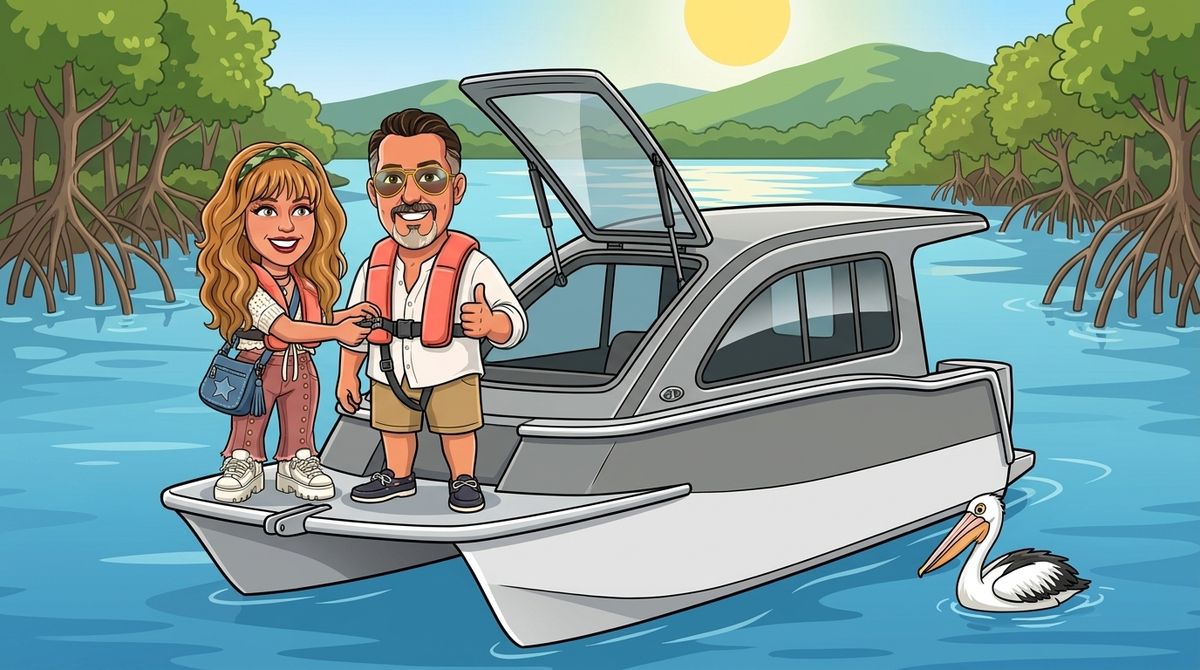
Cover illustration: JR & DJ cartoon by Cat Cruisers (AI-generated).