
Record Trips, Softer Sales: What the Latest Caravan Industry Numbers Mean for Buyers
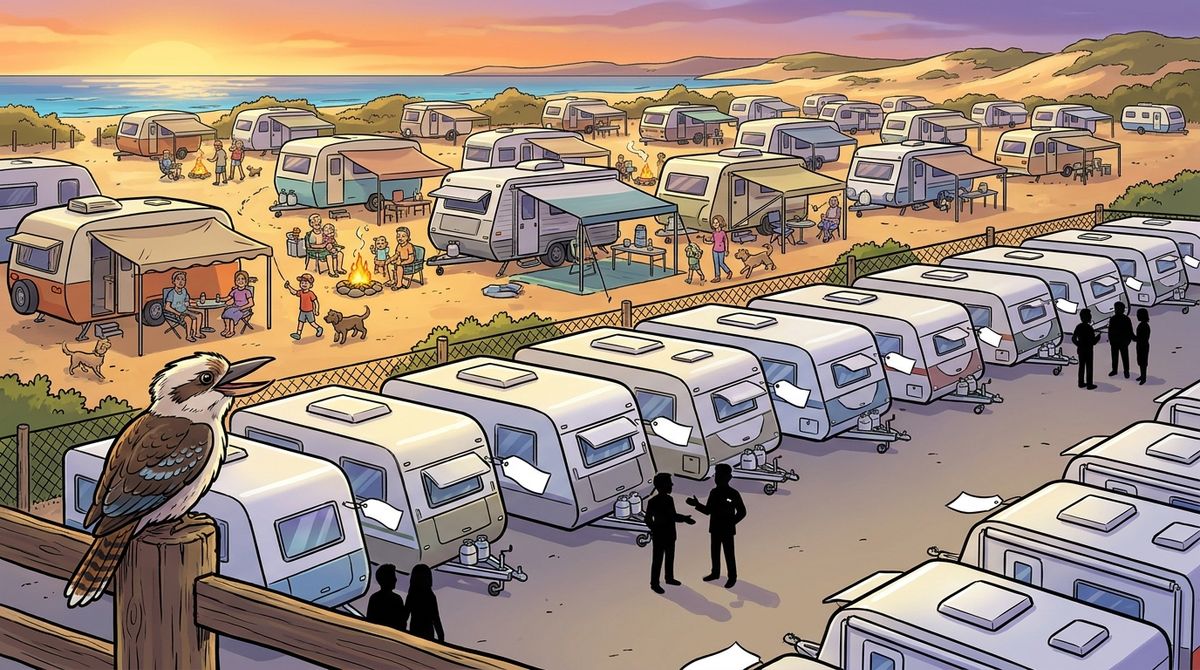
On 13 October 2026, the Caravan Industry Association of Australia quietly updated the national statistics page it treats as the industry's canonical scoreboard. Most years, that update would be insider fodder. This year, the numbers tell buyers something genuinely useful: Australians are travelling in record numbers, and the market they're buying into has shifted firmly in their favour.
The headline figures cover the year ending June 2026. Australians took 17.9 million overnight caravan and camping trips — up from 17.3 million in calendar 2025 — generating 60.8 million visitor nights and $13.6 billion in domestic visitor spend, up from $12.6 billion the year before.[1] Demand for the caravan lifestyle has never been higher.
And yet anyone who has walked through a dealership row lately knows the sales floor feels quiet. Both things are true at once. Here's how to read them.
The Demand Side: Travel Is Booming
Strip the numbers back and the picture is unambiguous. Australians are not falling out of love with caravanning — they're doing more of it:
- 17.9 million overnight trips in the year to June 2026, versus 17.3 million across calendar 2025.[1] 60.8 million visitor nights, up from 57.9 million in the prior period.[1] $13.6 billion spent by domestic caravan and camping travellers, compared with $12.6 billion the year before — and that earlier figure included glamping for the first time.[1] The second quarter of 2026 alone delivered 4.3 million trips (up 4% on Q2 2025), 14.5 million nights (up 10%), and $3.3 billion in visitor expenditure — up 18% year-on-year.[1]
The trip profile is also telling. The average caravan or camping trip now lasts 3.4 nights, with travellers spending an average of $757 per trip and $224 per night.[1] Holiday travel accounts for 80% of trips, and the 30–54 age bracket now makes up 42% of travellers — this is no longer a retiree-dominated pastime.[1]
Put simply: the product category is more popular than it has ever been. People are voting with their tow balls.
The Supply Side: A Market Flooded With Options
Now the other half of the story. In the twelve months to June 2026, 47,997 recreational vehicles were entered on Australia's Register of Approved Vehicles — 44,297 towable and 3,700 motorised.[1] On top of that, 23,244 caravan trailers and related components were imported into Australia in 2025, a 16% increase on 2024, with a combined free-on-board value of $619.2 million.[1]
That's an enormous volume of product chasing buyers at the exact moment the post-boom hangover has set in. The manufacturing shakeout that has claimed several well-known Australian builders over the past year — and the discounting that has followed — has been impossible to miss. Dealers and builders sitting on stock are motivated in a way they weren't in 2021.
The result is the textbook definition of a buyer's market: record demand for the lifestyle, but an oversupplied sales channel competing hard for a smaller pool of ready-to-hand-over-money customers.
What the Numbers Actually Mean If You're Buying
This is where the data gets practical. Four takeaways for anyone weighing up a purchase right now:
1. You're travelling with the crowd — and that's an asset, not a knock
With 17.9 million trips a year, the second-hand market stays liquid. If you buy well now and your circumstances change, there will be buyers. The same can't be said for every discretionary toy. A caravan (or a vessel) sits in the category Australians demonstrably keep using regardless of the economic weather — caravan parks alone turned over $3.3 billion in 2025, up 7%, with cabin occupancy hitting 69.7%.[1]
2. Use the soft sales conditions — they won't last forever
Trips are up 4%, nights up 10%, spend up 18%. Eventually the sales channel rebalances, and the leverage shifts back to sellers. Buyers who did their homework during the quiet period of 2026 will look very smart in hindsight. Negotiate on price, ask what's included, and don't be shy about comparing quotes across dealers — stock-heavy channels reward patient buyers.
3. Do the cost-per-trip maths before you commit
The average Australian caravan trip costs $757 all-in and runs 3.4 nights.[1] Before you buy, work out what your realistic annual trip count looks like, and what the annual cost of ownership (rego, insurance, storage, servicing, depreciation) divides out to per trip. If the honest answer is that the van will sit idle 48 weeks a year, the data is telling you something: single-purpose assets only make sense if you actually use them.
4. Consider what the numbers say about flexibility
Here's the stat worth sitting with: Australians are taking more, shorter trips and spending more per trip while they do it.[1] The lifestyle is shifting toward versatility — beach one weekend, lake the next, a longer run in school holidays. That's precisely the pattern a single-purpose caravan serves awkwardly and a multi-environment vessel serves naturally.
The Accommodation Numbers Behind the Boom
The demand surge is also reshaping what it costs to actually take a trip. Caravan parks analysed for the association (more than 460 of them) generated $3.3 billion in revenue in 2025, up 7% on the year before — and the growth came on the back of sharp occupancy jumps across every site type: cabins up 9.5 percentage points to 69.7%, powered sites up 9.6 points to 58.1%, and unpowered sites up a striking 14 points to 34.2%.[1]
Pricing has followed. The national average daily rate for a caravan park cabin sat at $212.78 in 2025, with powered sites at $62.27 and unpowered at $50.23 — and the most recent monthly read (September 2026) shows cabin rates up another 10% year-on-year at $210 per night, with cabin occupancy of 66.7%.[1]
For buyers running the cost-per-trip maths, this matters more than the sticker price of the van. If a powered site now averages more than $60 a night and a cabin north of $200, the economics of owning your own accommodation — and of alternatives that don't depend on a park booking at all — keep improving the more nights you travel. That's the quiet argument hidden inside the association's spreadsheet: the more Australia caravans, the more valuable self-sufficiency becomes.
The One Question the Data Can't Answer
Every number above describes a category, not your situation. The CIAA figures confirm that caravanning in Australia is a resilient, growing, high-participation lifestyle. They also confirm that the people selling into it are doing it tough right now — which is an opportunity for buyers who are prepared, financed, and clear-eyed about what they'll genuinely use.
The question the spreadsheet can't answer is the one worth asking in the showroom: how many environments do you want your leisure asset to work in? Land only, or land and water?
For buyers whose answer is "both," it's worth knowing there's an Australian-built amphibious option. Cat Cruisers handcrafts amphibious vessels on the Gold Coast, and both models in the range run on electric propulsion — drive to the water, transition from road to sea mode at the shoreline, and you skip the caravan-versus-boat arithmetic entirely. Explore the range at catcruisers.com.au.
The Bottom Line
The latest industry data, updated this week, shows an Australian caravan sector where demand is at record levels and the buying conditions are the best they've been in years.[1] More trips, more nights, more spend — and a sales channel that needs to move stock. If you've been sitting on the fence about joining the 17.9 million, the numbers are on your side. Do the per-trip maths, negotiate hard, and buy the asset you'll actually use.
Sources
1. Caravan Industry Association of Australia, "Australian caravan and camping industry statistics", updated 13 October 2026 (drawing on Caravan and Camping State of Industry 2026, 11th edition; Tourism Research Australia domestic tourism statistics, year ending June 2026; BITRE road vehicle entry statistics, June 2026; and Caravan Park Accommodation Insights, August 2026). https://www.caravanindustry.com.au/insights-campaigns/industry-statistics/