
How Quiet Electric Boats Protect Marine Life
How Quiet Electric Boats Protect Marine Life
By Jason Rieck
Co-Founder & Lead Designer, Cat Cruisers
When you switch off a petrol engine and drift in silence, you notice something remarkable: the water comes alive. Fish break the surface. Birds call from the shore. The gentle slap of wavelets against the hull becomes the only soundtrack. Now imagine that silence being your default, not a moment between engine starts, but the permanent state of your vessel. That is what electric boating offers. And for marine life, it matters more than most people realise.
A note from the builder
I'll put my cards on the table. I love quiet. Not the museum kind. The kind you get when you switch off and the bay starts talking. Birds. Fish hitting the surface. Water on the hull.
On a petrol boat that moment lasts until someone restarts the engine. On an electric boat it can be the whole day. I used to think silence was what happened when you anchored. Now I want that feeling underway as well. Soak up the ocean. Listen to the world. Leave the soundtrack to nature.
The science below is why that preference is not just a mood.
The Science of Underwater Noise
A peer-reviewed study by University College London and RAD Propulsion, published in the Journal of the Acoustical Society of America, found that electric propulsion reduced underwater noise by up to 43 decibels at 4 knots compared with a conventional engine of similar power. Every 10 dB reduction is perceived as roughly half as loud. A 43 dB reduction means the electric vessel is roughly 20 times quieter underwater than its combustion equivalent, at the slow speeds where most of us actually spend the day.
The biggest benefit is at low speed, where cavitation is minimal. The electric vessel also stayed quieter across the full speed range tested, from 4 to 20 knots. That matters because recreational boats spend most of their time loitering: fishing, swimming, lunching, watching wildlife. For the animals nearby, that is the noise they live with.
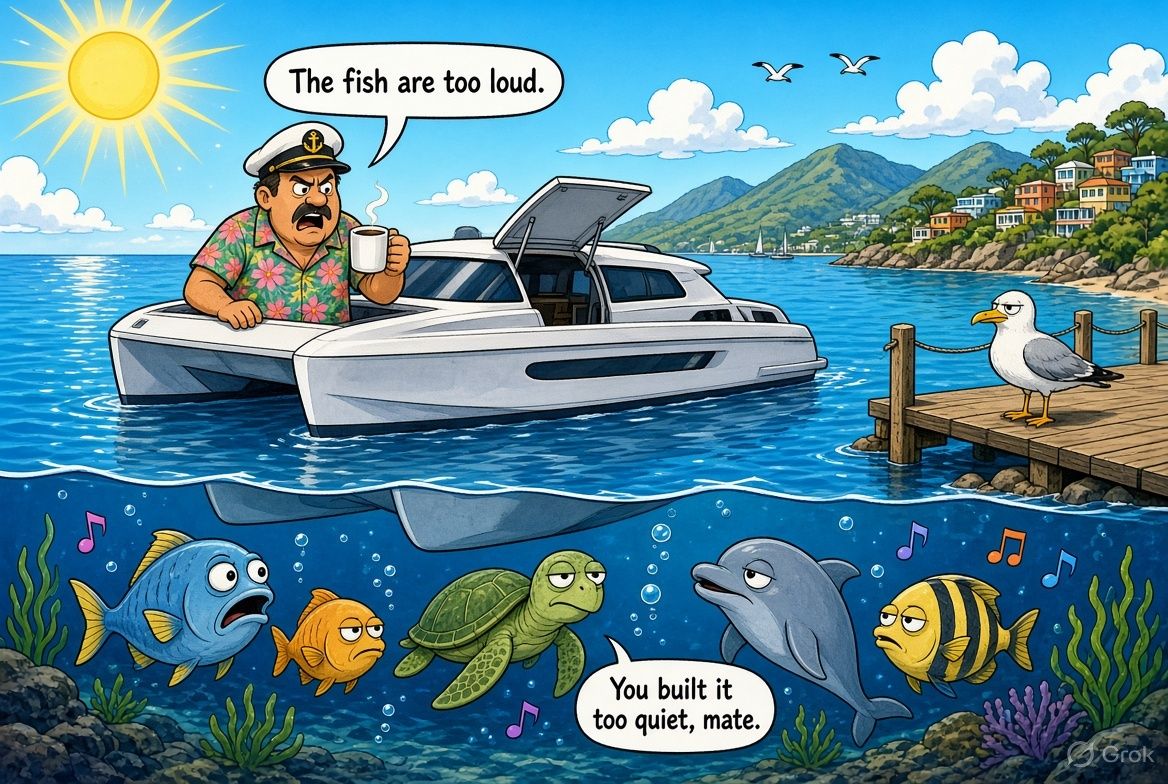
That is the bit the decibels do not capture. You can hear the afternoon. You are not shouting over your own machine. The fish do not have to shout either.
Impact on Whales and Dolphins
Marine mammals are particularly sensitive to underwater noise because sound is their primary sense. They use it to communicate, navigate, find food, and care for their young.
A 2021 study in Scientific Reports compared the same whale-watch vessel running a louder petrol engine and a quieter electric engine around short-finned pilot whale mothers and calves. During petrol-engine passes, mothers spent 29 percent less time resting and calves spent 81 percent less time nursing. The quieter electric engine produced no significant change compared with no vessel at all.
An 81 percent drop in nursing is not a minor interruption. Calves depend on that milk. The exact percentages belong to that pilot-whale study, not to every species in every bay. The principle travels. Humpbacks and southern right whales calve in Australian waters. They do not need a petrol soundtrack while they do it.
A natural experiment in the Bay of Fundy made the same point from the other direction. After shipping traffic dropped in September 2001, underwater ambient noise fell by about 6 dB and researchers recorded lower stress hormone levels in North Atlantic right whales.
Beyond Mammals: Invertebrates and Fish
The damage from underwater noise is not limited to the animals people come to photograph. Playback studies on sea hares found boat noise associated with about a 21 percent reduction in embryo development and 22 percent higher death rates. These are invertebrates at the base of the food web. When noise hits their reproduction, the effects move up the chain.
Fish are affected too. Many species use sound for spawning, predator detection, and territory. Chronic noise has been linked to higher stress hormones, reduced feeding, and animals leaving the habitat they would rather use. In busy recreational waterways, that adds up.
Australian Regulations and Approach Distances
Australian rules exist because the science is not theoretical. Under national guidelines, vessels must stay at least 100 metres from whales and 50 metres from dolphins. Caution zones extend to 300 metres for whales and 150 metres for dolphins, where speed must drop and sudden course changes stop.
On the Great Barrier Reef and in other Commonwealth waters, the rule tightens around calves: 300 metres from a whale calf and 150 metres from a dolphin calf. In Victoria, jet skis must stay 300 metres from dolphins. Check your state. The distances are a minimum, not a target.
From the builder
I did not start building electric cats so I could write a paper. I started because I wanted the anchored-quiet feeling for the whole adventure. The marine life is not a marketing extra. If the water is quieter, everyone on it has a better day. Including the ones who live there.
Petrol is a conversation you cannot join. Electric is the afternoon you actually came for.
Cat Cruisers vessels are electric. Silent running is not a button you press at lunch. It is how the boat moves. To see the boats, visit catcruisers.com.au or get in touch at catcruisers.com.au/contact.