
Taree-built teardrop campers give EV owners a lightweight towable that won't drain the battery
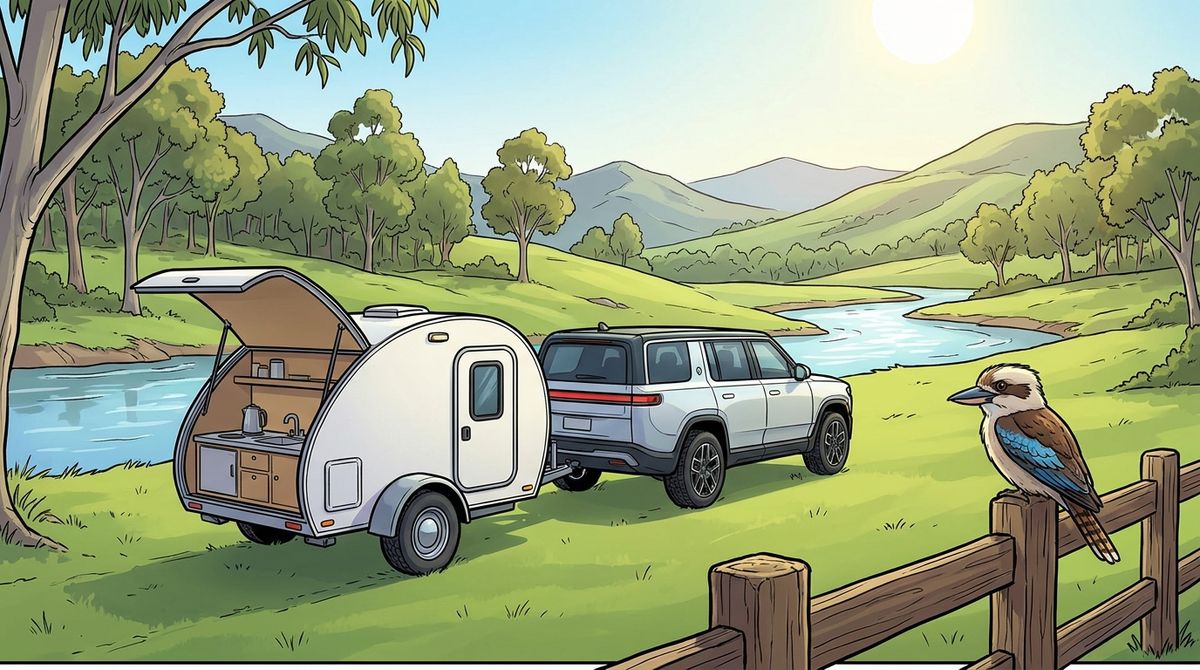
For 40 years, the boilermakers at Taree's Agrifarm have welded steel for heavy-duty agricultural machinery. Now the mid-north coast NSW workshop has pivoted to something far more portable: teardrop camper trailers light enough to be pushed into a campsite by hand — and aimed squarely at electric vehicle owners who want to tow without torching their range.
The company, trading as Little Guy Australia, builds the compact fibreglass, steel and laminated-timber campers from the ground up in Taree. Production manager Brad Shaw says the pitch is simple: caravan freedom without a four-wheel-drive tow rig. "It's a very easy entry level into getting a bit of freedom," Shaw told the Manning River Times this week. "You do not have to change your vehicle."[1]
That matters more than it used to. Australia's EV fleet has grown fast, but towing remains the use case that makes buyers nervous — add a conventional caravan and range can drop sharply. Little Guy's answer is to attack the problem at the source: trailer weight.
Why weight is the whole story for EV towing
The physics of towing an EV are unforgiving. A heavy tandem-axle caravan behind a mid-size electric SUV means more energy per kilometre, more heat in the battery pack and more time plugged in at the next charger. Cut the trailer's mass dramatically and most of that penalty shrinks with it.
Little Guy's figures, published by the manufacturer, show how far the weight has been cut:[2]
- From $19,900 (Deluxe): the lightest model, rated to be towed by the smallest cars and manoeuvred by hand Deluxe Plus ($21,700): queen-size mattress, refrigerator and water tank, only marginally heavier Cruiser ($23,000): extended chassis with a front platform and double the under-bench storage Rough Rider ($26,000): off-road suspension and 15-inch wheels for unsealed roads
Trade title Caravan World has weighed a Little Guy at as low as 350kg — manufacturer materials describe that as "almost towed by a bicycle" territory, and the trailers are built in Taree from Australian steel.[2][3] For context, a typical modern full-size Australian caravan often weighs two to three tonnes loaded. The teardrop isn't a stripped-back compromise at that weight so much as a different product category entirely: a lock-up sleeping cabin with a rear kitchen galley, 12V and 240V power, LED lighting, insulation to R-1.2 in the roof, and zero canvas to pitch.[2]
The lightweight pitch is already converting buyers who were never going to own a LandCruiser. "A lot of single ladies come in with MGs or Suzuki Vitaras. It falls well within the capabilities," Shaw said.[1] Little Guy marketing manager Sam Wallis recorded 12L/100km towing one behind a 2012 Nissan X-Trail on a test run from Wingham — petrol numbers, but a useful proxy for how little mass the tow vehicle has to move.[1]
From farm machinery to fibreglass
The pivot hasn't been seamless. Agrifarm's boilermakers had to learn laminating and timberwork, and sourcing parts locally proved harder than expected — the company initially found Taree suppliers reluctant to quote, forcing it to keep shipping kitchen fit-outs from Adelaide, where Little Guy Australia was originally founded.[1]
The supply chain is slowly localising. Taree Auto Electrics now builds the wiring harnesses, and local timber craftspeople have come on board. It's a small but telling example of what Australian manufacturing diversification actually looks like: not a grant announcement, but a regional workshop retraining welders and finding a niche the imports haven't bothered with.[1]
The product itself is old-school in the best sense. Every model runs a welded steel tube frame with powder-coated finish, laminated fibreglass exterior panels, a roof vent with fan, fully insulated roof, and both 12V and 240V electrics as standard — including an Anderson plug feed suitable for a solar panel.[2] There are no touchscreens, no app subscriptions and no firmware updates to schedule before a long weekend. For buyers coming to EVs partly for the simplicity of the drivetrain, a camper with the same philosophy is an easy sell.
There is also a second-hand story worth watching. Teardrops hold value unusually well because their fibreglass shells don't rot and their running gear is trailer-standard, and a used lightweight camper is one of the few ways into EV towing for buyers on a tighter budget. Watch the classifieds alongside the new-order queue if delivery timeframes stretch.
The market tailwind
The timing is not accidental. Australians took a record 17.3 million caravan and camping trips in 2025, according to the State of the Industry 2026 report — but average trip length shrank to 3.4 nights as fuel costs pushed travellers toward shorter, closer itineraries.[4] Recreational vehicle insurer CIL, in the same reporting, found grey nomads were cutting daily distances and choosing nearer destinations to manage fuel bills.[4]
That cost pressure is precisely where a lightweight electric-friendly towable wins. The national average for a powered caravan park site runs between $55 and $62 a night, per Caravan Industry Association of Australia data — and an EV towing a small trailer plugs into the same post, absorbing the next day's driving range into an accommodation fee the traveller was paying anyway.[4] Compare that with a diesel tow rig where the $150 bowser stop sits on top of the site fee.[4]
Where this sits in the e-RV picture
The teardrop sits at the opposite end of the market from the factory-built electric campervans starting around $120,000 that have been drawing headlines this year. Both are responses to the same pressure — diesel prices, emissions concerns and the appeal of running costs measured in cents per kilometre — but the teardrop solves it with a $20,000 trailer behind the car the household already owns.
There is also a licensing sweet spot. Trailers this light generally sit well under the thresholds that trigger heavier towing requirements, and because the tow vehicle does most of the braking, small-car owners stay within the limits their everyday vehicle was engineered for. For the growing number of households whose first and only car is electric, that means no second vehicle, no 4WD upgrade and no trade-in conversation — just a hitch, a wiring loom and a long weekend.
For EV owners specifically, the arithmetic is straightforward. Compact electric SUVs sold in Australia carry braked tow ratings in the hundreds of kilograms rather than the two-tonne-plus figures of large 4WDs — enough headroom for a 350kg-class trailer, and well short of what any conventional caravan requires. Check your own vehicle's rating in the owner's manual before committing, but for a large share of the EV fleet the Little Guy's weight class is inside the limit, not at the edge of it. Overnight at a powered site, the trailer's battery systems charge from the same 240V outlet the car uses.
Practical guidance for EV owners eyeing a towable
If you're an EV owner considering a small camper, the checklist is shorter than the caravan industry's:
- Check your tow rating, not just range. Many compact EVs are rated to tow 750kg braked; verify your specific model's limit before shopping. Weigh the trailer, believe the scales. Published tare weights are unladen — ask the manufacturer for the ATM (aggregate trailer mass) and keep payload realistic. Aero matters at highway speed. Teardrops have a low frontal area; still, expect range loss on motorway legs and plan charging stops around it. Test the hitch weight. Ball weight should sit within the vehicle maker's limit, typically 50–75kg for small EVs. Powered sites become dual-fuel stops. One 15-amp outlet can top up the car and the camper overnight, which is where the real running-cost gap over diesel opens up. Pack for the trailer, not the car. With a camper this size there is no room for the "just in case" garage of gear that follows a big van — a fridge, a camp chair each and a change of clothes is about the limit, and that discipline saves battery as well as money. Trial-tow before you commit. Hire or borrow a similar-weight trailer for a weekend run past your nearest DC fast charger; real-world consumption with your load beats any brochure figure.
Australian-made, sub-$30,000 and towable by the kind of car most households actually drive, the teardrop is the least glamorous and possibly most practical corner of the country's emerging electric RV market. The AdventurEV Group has been tracking the local e-RV and conversion sector as products like this shift from novelty to showroom staple, and the Taree build is notable precisely because it's unremarkable engineering — light weight, local steel, a fair price.
Forty years of farm machinery experience, it turns out, translates reasonably well to a camper you can push uphill. As the charging network keeps filling in the map beyond the capitals, the case for keeping the trailer light and the tow vehicle electric only gets stronger — and for now, at least, some of the cleverest examples of that combination are being welded together in Taree.
Sources
1. Manning River Times, "Taree's Agrifarm builds new teardrop campers for EV drivers", October 2026. https://www.manningrivertimes.com.au/story/9370017/tarees-agrifarm-builds-new-teardrop-campers-for-ev-drivers/
2. Little Guy Australia, "Models" (specifications and pricing), 2026. https://www.littleguyaustralia.com.au/models
3. Little Guy Australia, official site (manufacturer materials, including Caravan World weigh reference), 2026. https://www.littleguyaustralia.com.au/
4. The Senior, "Campervan EVs do exist and cut road trip costs for grey nomads", 2026. https://www.thesenior.com.au/story/9352928/campervan-evs-do-exist-and-cut-road-trip-costs-for-grey-nomads/