
The Caravan Market Just Flipped. Motorhomes Are Surging While Towables Cool — Here's What Buyers Should Do
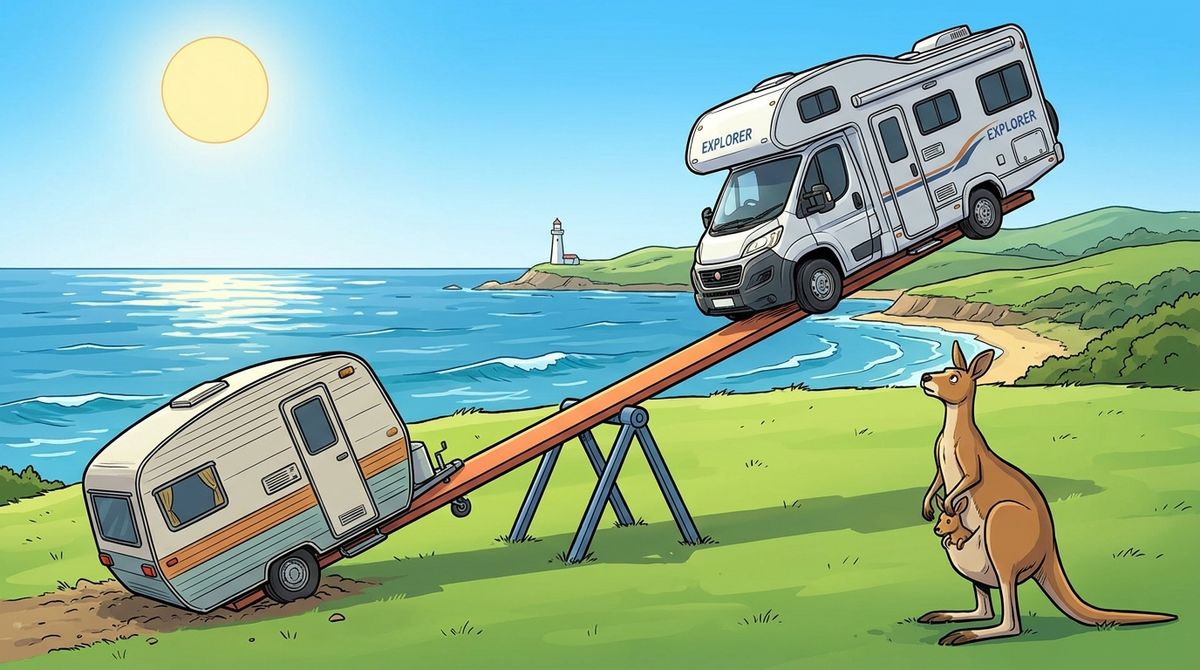
On 23 September 2026, the latest Register of Approved Vehicles data landed — and it confirmed what caravan dealers have been whispering all year: the market has genuinely flipped.
According to July 2026 RAV figures compiled by the Caravan Industry Association of Australia, just 3,728 RVs entered the register during the month — a 10.8% decline on the same month last year. But the headline number hides the real story. The traditional towable market — caravans, hybrids and camper trailers — fell 14% year-on-year to 3,362 units, while motorised RVs bucked the trend entirely, continuing a surge that has been building through 2026. [1]
In plain terms: Australians haven't stopped buying RVs. They're buying different ones — and the brands they're choosing has changed just as much as the category.
If you're in the market for a van (or a boat-caravan, or a motorhome) in the next 12 months, this shift matters more than any single model release. Here's the data, and what to do with it.
What the July Numbers Actually Show
The monthly brand leaderboard tells the story of a market in transition: [1]
- Regent RV (Snowy River) topped July with 356 entries — an import-built brand now leading the Australian market. Jayco, the long-time industry giant, slipped to 318 entries, down 19.9% year-on-year. Import-focused brands are growing fast: Ezytrail surged 26.5% and Stoney Creek Campers grew 14.3% compared to July 2025. Established Victorian manufacturers went the other way: Crusader fell 17.4% and Leader dropped 16.7%.
Zoom out to the year-to-date picture (January–July 2026) and 27,110 RVs have entered the RAV, including 24,720 towables. Jayco still holds the YTD towable lead at 3,180 entries, but Snowy River (1,875), Austrack (1,864), MDC (1,625) and Ezytrail (1,437) are now permanent fixtures at the top of the table alongside the legacy local names. [1]
And the structural shift is bigger than any single month. In 2025 — for the first time — imported RVs matched locally built ones, with 23,244 import units (up 16% on 2024) landing against 23,963 locally built, according to CIAA figures. Total 2025 RAV registrations came in at 43,819, down slightly from 44,358 in 2024. [1][2]
Why Motorhomes Are Winning Buyers
The motorised surge isn't a mystery — it's the market responding to exactly the friction points that have always annoyed caravanners.
As RV commentator coverage of CIAA's monthly Production IQ data has noted through 2026, motorhomes and campervans suit buyers who want travel to feel simple: no hitching up, no reversing a van into a tight site, no matching tow vehicle to van weights, no worrying whether the combination is legal for your licence. You pull in, park up, sleep, move on. [3]
That's increasingly attractive to three buyer groups:
- Couples and empty-nesters doing shorter, more frequent trips — the average Australian RV trip is now just 3.4 nights, and travellers are booking later and staying closer to home. [2] Solo adventurers who don't want to manage a two-vehicle setup alone. Value-conscious buyers comparing the total cost: a motorhome is one vehicle to register, insure and store — not a car plus a van plus the storage fees for both.
None of which means the caravan is dead. Towables still dominate the market outright (24,720 of 27,110 YTD entries). But the buyer who once defaulted to a caravan is now genuinely cross-shopping, and the industry's product mix is reshaping around them.
The Other Story: Imports Have Caught Local Manufacturing
The 2025 import milestone — 23,244 imported units versus 23,963 local builds — deserves its own paragraph, because it reframes the whole "support local" debate. [2]
The growth in imports isn't just about price. Chinese-built vans have improved enormously, with 5-6m and over-6m towables (the dominant segments) now available with fit-outs and equipment that would have been premium-spec five years ago. The import freight value confirms the volume is real, not a one-off: $619.2 million FOB, up 12.6% on 2024. [2]
For buyers, that's genuinely good news — more competition, sharper pricing, faster availability. But it comes with the caveat our industry has learned the hard way this year: several well-known local builders have collapsed under the price pressure, and buyers who paid deposits to some of those brands are now creditors in administration proceedings. If you're buying imported or local in this market, the vetting matters more than the badge.
What This Means If You're Buying in the Next 12 Months
A cooling market with shifting demand is, bluntly, a buyer's market. Here's how to use it:
1. You have leverage on price — use it.
When registrations are down double digits and dealers are carrying stock, the advertised price is a starting point, not a number. Get competing quotes in writing, including delivery timelines. Builders chasing cash flow will deal.
2. Cross-shop the category, not just the brand.
With motorhomes surging and towables soft, some of the best relative value in 2026 is sitting in lightly used towables — especially the 5-6m family segment, which has held up better than small vans. Compare a used quality caravan against a new budget motorhome on total cost of ownership before deciding.
3. Vet the builder's stability before paying a deposit.
Ask how long they've been trading, check their compliance plate records, search their name on the ASIC register, and pay deposits by credit card where possible. In a market where local builders are failing under import price pressure, this check is not optional.
4. Check the after-sales reality, not the brochure.
With import brands now leading monthly registers, ask specifically: who services this van within 200 km of home? Where do parts come from? A five-year warranty from an established local operation and a five-year warranty from an import distributor are not the same product.
5. Think about utilisation before anything else.
The market's core problem is overcapacity chasing buyers who don't use their asset much. Whatever you buy, the question that predicts satisfaction isn't "which van?" — it's "how many nights a year will I actually be in it?" If the honest answer is under four weeks, consider whether a multi-purpose option (a vessel you can sleep on, a van you can hire rather than own) fits the lifestyle better than a single-purpose purchase.
The Bottom Line
The Australian RV market isn't collapsing — it's rotating. Towables are cooling, motorhomes are surging, imports have caught local manufacturing, and the buyers holding the cards right now are the ones prepared to cross-shop and negotiate. That's you, if you do the homework.
Cat Cruisers builds Australian-made amphibious vessels on the Gold Coast, so we watch these market swings closely — the same utilisation maths that drives the caravan debate is exactly why multi-purpose vessels exist. Whatever you buy, buy it to use it.
Sources
1. caravancampingsales.com.au staff, "Caravan market cools as motorhomes surge", 23 September 2026. https://www.caravancampingsales.com.au/editorial/details/caravan-market-cools-as-motorhomes-surge-153093/
2. Max Taylor, GoRV, "State of the Australian Caravan Industry", 13 July 2026. https://gorv.com.au/state-of-the-australian-caravan-industry/
3. What's Up Downunder, "Would you still buy a caravan in 2026? New RV data suggests buyers may be thinking twice", 2026. https://whatsupdownunder.com.au/research/news/would-you-still-buy-a-caravan-in-2026-new-rv-data-suggests-buyers-may-be-thinking-twice/