
Toyota HiLux BEVs enter live production at BHP's Goonyella Riverside mine
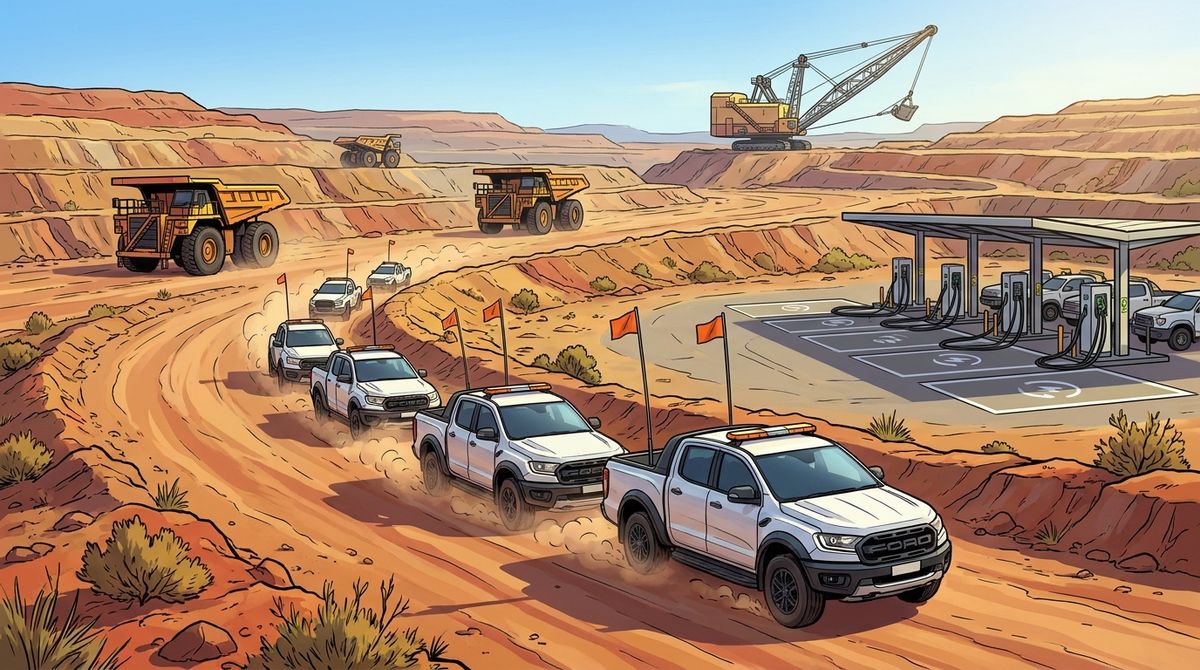
Battery-electric haul trucks get the headlines, but the most instructive mining electrification story in Australia right now is a pair of utes. Two Toyota HiLux BEVs have begun operating at BHP Mitsubishi Alliance's (BMA) Goonyella Riverside coal mine in Queensland's Bowen Basin, moving battery-electric light vehicle technology from trial phase into a live production environment.[1]
The deployment, reported by International Mining on 2 October, builds on the industry-first HiLux BEV trial BHP and Toyota Australia announced in October 2024, when a single electric HiLux double cab prototype began a 12-month stint at BHP's Port Hedland operations in Western Australia.[2] That trial was about proving the vehicle. This one is about proving everything else — the charging infrastructure, the operational procedures and the workforce readiness needed to run electric light vehicles in a working mine.
What was announced
According to International Mining, two HiLux BEVs are now in service at Goonyella Riverside, one of BMA's largest open-cut coking coal mines, located near Moranbah in central Queensland. The vehicles are supported by dedicated charging infrastructure using Ocular Orion DC CCS2 chargers.[1]
BHP's framing of the deployment is notable for what it emphasises — and what it doesn't. "While the vehicles are an exciting milestone, the bigger story is what it takes to run them in a working mine: the infrastructure, operational capability and workforce readiness needed to operate safely and effectively at scale," the company said in a statement carried by the publication.[1]
Adam Lancey, Asset President for BHP Mitsubishi Alliance, told International Mining the site was chosen deliberately as a proving ground: "Goonyella is one of BHP Mitsubishi Alliance's largest mines and it's well placed to help us understand how our new technology can be introduced safely and effectively in a complex operation."[1]
He added: "Electrification remains our preferred long-term pathway to reduce operational emissions from diesel and we need to build capability for the future. This is an important step in understanding what it takes to electrify mining operations at scale. Projects like this are helping lay the foundations for the next phase of our decarbonisation journey."[1]
Why light vehicles are a different problem to haul trucks
Mining electrification coverage in Australia tends to focus on the 240-tonne haul trucks — the Pilbara trials run by BHP, Rio Tinto and Caterpillar, and Fortescue's competing programs. Those machines are the biggest single source of diesel emissions on a mine site, but they are also the hardest to electrify, which is why they remain in early-learner trial phases.[3]
Mine site light vehicles — the utes that carry supervisors, crews, tools and samples around a site — are a different proposition entirely:
- The duty cycle suits battery power. Light vehicles on a mine site typically cover short, predictable distances between parked charging windows. The charging is simpler. The HiLux BEV charges at up to 150kW DC or 10kW AC — infrastructure that already exists at scale in the public network, unlike the megawatt-class charging haul trucks require.[4] The replacement volume is significant. BHP alone has around 5,000 light vehicles across its Australian operations, a fleet its President Australia Geraldine Slattery flagged for electrification ambition when the Toyota trial was announced.[2] The feedback loop is faster. A ute accumulates real-world duty data far quicker than a haul truck running scheduled trial laps, which is why two vehicles at one coal mine matter more than their size suggests.
The vehicle itself
The HiLux BEV entering service at Goonyella Riverside is the production-intent version Toyota Australia revealed in late 2025, targeted primarily at mining, farming and fleet buyers rather than private customers.[5] Key details confirmed at launch:
- Dual e-Axles driving all four wheels (roughly 205Nm front, 268Nm rear) with full-time electronically controlled all-wheel drive Five-mode multi-terrain select system (Rock, Sand, Mud, Dirt, Moguls) 700mm wading depth, 218mm ground clearance, 29-degree approach and 25-degree departure angles 2.0-tonne braked towing capacity and payload around 725kg for pick-up variants DC fast charging at up to 150kW, plus 10kW AC
CarsGuide, which drove the HiLux BEV in 2026, noted the vehicle's modest range figures make sense only in context: it is built for mine sites where vehicles return to base regularly, not for long highway legs.[4] Pricing starts around $75,000 for the SR variant — a number mine operators weigh against diesel running costs, maintenance and site refuelling logistics rather than against showroom rivals.
The bigger picture
The Goonyella deployment is one strand of a broader pattern. In the Pilbara, BHP and Rio Tinto are trialling Caterpillar 793 XE battery-electric haul trucks at Jimblebar, with dynamic (in-motion) charging infrastructure to be commissioned in FY2027.[3] In June 2026, Volvo began building battery-electric heavy trucks at its Wacol plant in Brisbane — the first OEM electric truck production in Australia — with logistics firm Linfox taking the first 30 units.[6]
For Australian mine operators, the practical sequence is becoming clearer: electrify the light fleet first (proven vehicles, standard charging, short duty cycles), learn the operational lessons, and apply them to the heavy end as haul-truck technology matures. The two HiLux utes at Goonyella Riverside are, in that sense, a training exercise for the whole site — charging management, maintenance workflows, workforce familiarity — as much as they are an emissions reduction measure.
There is also a domestic capability angle. As miners build fleets of converted and factory-electric light vehicles, demand grows for the conversion, fit-out and charging-infrastructure skills that Australian workshops and specialists supply — a supply chain the Australian EV Group has been watching closely as site electrification moves from pilot programs to procurement lists.
What it means for operators and suppliers
For mine operators and fleet managers watching this space, the Goonyella deployment offers a few takeaways:
- Start with the duty cycle, not the vehicle. BHP chose its largest BMA site deliberately; matching vehicle range and charging windows to actual route profiles is the first step in any electrification assessment. Budget for infrastructure alongside vehicles. BHP's own statement put charging infrastructure and workforce capability ahead of the vehicles as "the bigger story."[1] Expect vehicle supply to tighten. Toyota is prioritising mining, farming and fleet buyers for early HiLux BEV allocation, so retail and smaller-fleet buyers face waits regardless of willingness to pay. Watch the trial-to-fleet conversion rate. The 2024 Port Hedland trial produced this deployment; what Goonyella produces next — a broader BMA rollout, or more pilots — will signal how quickly the light-vehicle fleet turns over.
For the conversion and fit-out industry, every mine-site electrification program creates adjacent work: auxiliary power, canopy and tray fit-outs, communications gear and charging installation. The vehicles are Toyota's; the ecosystem around them is where local suppliers will find their entry points.
Sources
1. International Mining, "Toyota and BHP build on HiLux BEV trial with deployment at Goonyella Riverside", 2 October 2026. https://im-mining.com/2026/10/02/toyota-and-bhp-build-on-hilux-bev-trial-with-deployment-at-goonyella-riverside/
2. BHP, "Toyota Australia and BHP to trial first-ever battery-electric HiLux double cab", October 2024. https://www.bhp.com/news/media-centre/releases/2024/10/toyota-australia-and-bhp-to-trial-first-ever-battery-electric-hilux-double-cab
3. BHP, "BHP, Rio Tinto and Caterpillar launch battery-electric haul truck trial in the Pilbara", June 2026. https://www.bhp.com/news/media-centre/releases/2026/06/bhp-rio-tinto-and-caterpillar-launch-battery-electric-haul-truck-trial-in-the-pilbara
4. CarsGuide, "Toyota HiLux Electric 2026 review: BEV — Australian first drive", 2026. https://www.carsguide.com.au/ev/toyota-hilux-bev-102182
5. RACQ, "Toyota HiLux goes electric", 2026. https://www.racq.com.au/articles/car-updates/toyota-hilux-goes-electric
6. Australian Manufacturing, "Volvo rolls out first Australian-made OEM electric trucks from Wacol plant", 2026. https://australianmanufacturing.com.au/volvo-rolls-out-first-australian-made-oem-electric-trucks-from-wacol-plant