
What Size Boat Do You Need? A Sizing Guide
What Size Boat Do You Need? A Sizing Guide
By Jason Rieck
Co-Founder & Lead Designer, Cat Cruisers
Choosing the right size boat is one of the most consequential decisions you will make as a buyer. Too small, and you will outgrow it within a season. Too large, and you will spend more time and money on maintenance, storage, and logistics than you do on the water. Getting it right means understanding not just what you want to do, but what Australian regulations, towing rules, and real-world costs look like at each size bracket.
A note from the builder
I have a size opinion, and it is not subtle. Under 10 metres.
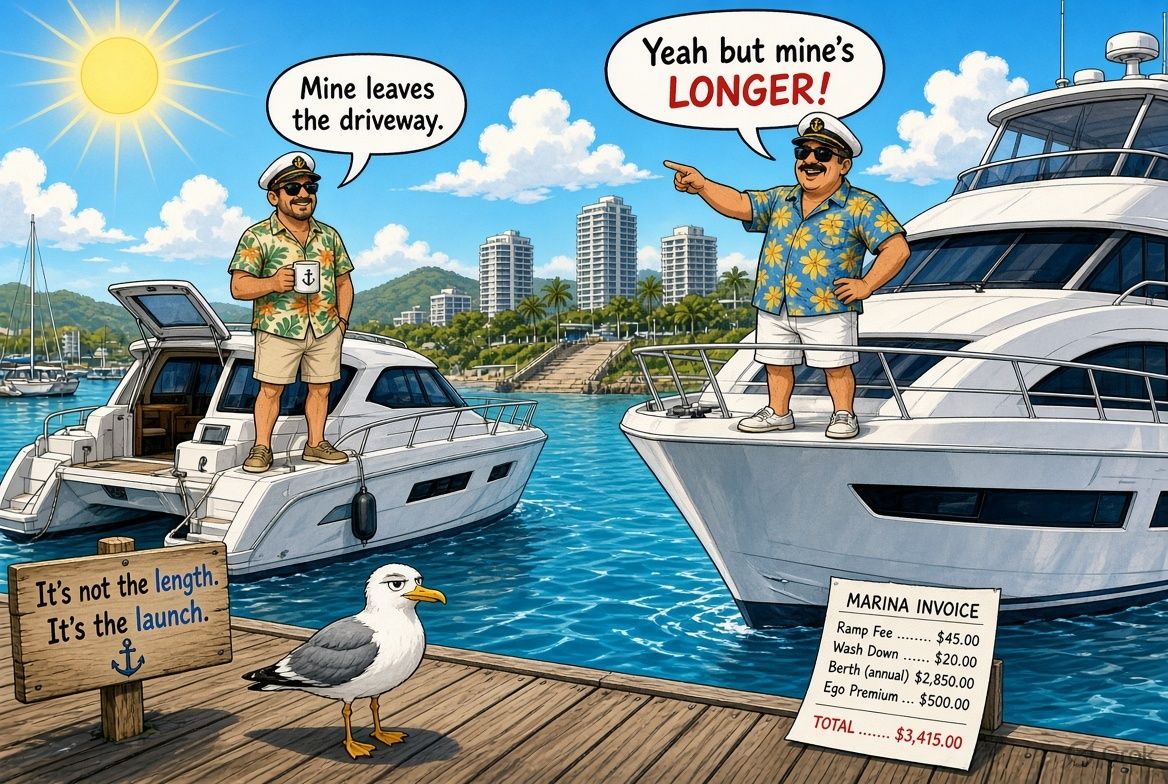
Not because big boats are the enemy. Because you can hitch it up on a Saturday and go wherever a ramp exists. You can store it in the driveway. You can hose it off before lunch without hiring a rope team. Cross 10 metres and the boat starts asking for a marina, a roster, and a second personality. A boat you can walk around at home is a boat you will actually wash. A boat that lives in a berth develops a lifestyle. So do the barnacles.
Now the useful version.
Understanding Boat Measurements
Two measurements matter most when sizing a boat. LOA (Length Overall) is exactly what it sounds like: the total length of the vessel from bow to stern. Beam is the width at the widest point. Both measurements affect where you can take the boat, how it handles, and critically in Australia, whether you can legally tow it.
Understanding these measurements before you buy prevents expensive surprises. A boat that is 10 centimetres too wide for standard towing means every trip to the water requires oversize load permits, escorts, or route restrictions.
Australian Towing Regulations
The maximum trailer width generally permitted on Australian roads without special permits is 2.50 metres. This is a widely applied limit that covers the boat-on-trailer combination at its widest point, including fenders, rod holders, and anything else that protrudes. Oversize loads beyond this may be permitted in some states with appropriate warning signs, flags, and speed restrictions, but requirements vary by state and road authority, so always check current rules with your local transport department before you tow.
Oversize loads are typically limited to a reduced maximum speed outside built-up areas and may need to travel with headlights on during the day. Some roads and bridges have additional width restrictions. These rules make trailering an oversize boat significantly less convenient and add time to every trip.
This is particularly relevant for buyers considering imported boats. Many popular overseas-market vessels have a beam wider than the standard Australian towing limit, which means they can require oversize treatment every time they are trailered. Always check the beam measurement against your state's standard towing width limit before committing to a purchase, and treat any figures here as general guidance rather than legal advice.
Small Boats: 4 to 6 Metres
The 4 to 6-metre range is where most Australians start their boating journey. Vessels in this bracket are best suited to day fishing, protected waterway cruising, and close-to-shore adventures. Prices vary widely depending on brand, condition, and fit-out, but this remains the most accessible entry point into boating. They are easily trailered behind most vehicles and can be launched from virtually any boat ramp.
Running costs at this size are relatively modest, covering registration, insurance, maintenance, fuel, and safety equipment. Storage is typically at home on the trailer, eliminating marina or mooring fees entirely.
The limitation of this size bracket is capability. In open water or significant chop, small boats get uncomfortable quickly. Overnight accommodation is minimal to non-existent. For a family of four, space can feel tight after a full day.
Mid-Size Boats: 6 to 10 Metres
The 6 to 10-metre range is the sweet spot for many Australian families. These vessels can handle more water than a tinnie, offer cabin accommodation for overnight trips, and provide enough deck space for comfortable day cruising with a group. Cabin cruisers, walkaround boats, and larger centre consoles all fall in this bracket.
This is also my sweet spot. Big enough to sleep on. Small enough to hitch to the car and disappear for the weekend. Friday night you are on the Gold Coast Broadwater. Saturday you are in Moreton Bay. Sunday the boat is back in the driveway looking innocent.
Many boats in this range remain trailerable, though towing requires a suitably rated vehicle and a bit of practice reversing at the ramp. The beam becomes a critical consideration here. Checking your vessel stays within your state's standard width limit is essential for hassle-free trailering.
Under 10 metres is the point where you still get a cabin, and you do not need a truck, a marina, or a spreadsheet to go somewhere new.
Large Boats: 10 Metres and Above
Once you cross the 10-metre mark, you are generally looking at permanent marina or mooring accommodation. These vessels are too large and heavy for regular trailering. Running costs step up accordingly, with marina berthing, servicing, and insurance forming a much larger annual commitment than a trailerable boat.
The benefits are genuine: comfort, capability, range, and the ability to spend extended periods aboard. A bigger boat is more boat to love. It is also more boat to scrub, more boat to store, and more boat that cannot come home with you on Sunday afternoon.
For many owners, the boat becomes a second home in both enjoyment and expense. If that is the life you want, fair enough. If what you actually want is more weekends on the water, measure twice.
The Right Size for the Right Life
The best boat is the one you actually use. A trailerable vessel that you can launch on a Saturday morning impulse will see more water time than a marina-based cruiser that requires planning, travel, and a day cleared of other commitments.
For most Australian families, the trailerable sweet spot — a well-designed vessel in the 6 to 8-metre range that fits within standard towing width — offers the best balance of capability, convenience, and cost.
If you can tow it, you will use it. If you can store it in the driveway, you will actually go. If you can wash it before lunch, you will still like it on Monday. That is the secret nobody puts in the brochures.
Cat Cruisers vessels are built under 10 metres, within trailerable dimensions, and designed to tow behind a suitably rated vehicle. You launch from a standard public boat ramp, get the stability and space of a catamaran on the water, and keep a cabin that works for a day afloat or a night camped by the shore.
To explore which model suits your needs, visit catcruisers.com.au or get in touch at catcruisers.com.au/contact.