
What the Coalition's NVES repeal pledge means for ute buyers, towers and the conversion industry
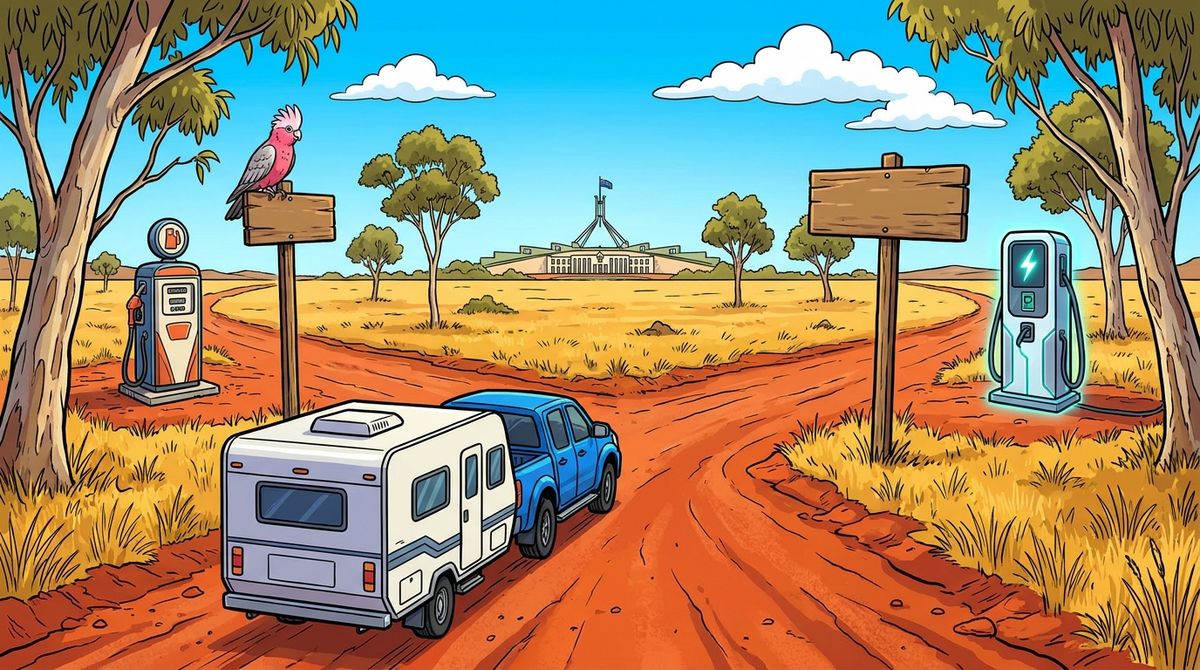
On 23 September 2026, Opposition energy and emissions reduction spokesman Dan Tehan stood up at The Australian's Energy Nation summit and confirmed what the car industry had been quietly dreading: a future Coalition government would introduce legislation within 30 days of taking office to repeal the New Vehicle Efficiency Standard (NVES) entirely.[1]
The pledge, part of a broader "Scrap Net Zero (Cheaper Energy) Act" that would also ditch legislated climate targets and the Safeguard Mechanism, reframes the NVES as a "family car and ute tax" — language aimed squarely at the diesel ute and four-wheel-drive buyers who make up a huge slice of Australia's new-vehicle market.[1][2] But the reaction from inside the industry has been far from celebratory, and for anyone who tows a caravan, runs a work ute or has been watching the slow arrival of electric 4x4s, the story is more complicated than the slogan.
What the NVES actually does
The NVES, which commenced on 1 January 2025 under the New Vehicle Efficiency Standard Act 2024, does not ban any vehicle. It requires manufacturers and importers to meet progressively tighter average CO2 targets across their new passenger car and light commercial vehicle fleets — utes, vans and 4WDs included — or face penalties.[2]
Suppliers that beat their targets earn credits; those that miss them can buy credits or pay a fine. The NVES Regulator is explicit that brands can keep selling any vehicle type they like, provided the fleet average lands under the cap.[2] In practice, the scheme pressures brands that lean heavily on large diesel utes — Ford (Ranger, Everest), Isuzu (D-Max, MU-X), Mitsubishi (Triton) — to offset those sales with efficient and zero-emission models, or push their prices up to cover penalties.
The standard's targets apply separately to passenger cars and light commercial vehicles, so utes and vans are judged against their own fleet average rather than against hatchbacks — a design choice meant to keep work vehicles available while still bending the curve. The current review of the standard, due to report on settings beyond 2029, has been flagged by both the EV Council and the FCAI as the appropriate place to adjust the rules, rather than tearing up the Act itself.[3][6]
The practical effect so far has been measurable. Federal Chamber of Automotive Industries (FCAI) chief Tony Weber puts the count at 132 battery-electric models and 80 plug-in hybrids now on the Australian market, and the BYD Atto 1 has been offered at $19,990 drive-away — Australia's cheapest new car.[3] Battery-electric vehicles hit 24.9 per cent of all new car sales in August, outselling petrol for the first time in a single month, and the national fleet passed 500,000 BEVs on World EV Day, 9 September.[4][5]
The Coalition's case
Tehan's argument is cost-of-living framed. "Australia should have an energy system built around three non-negotiable principles: affordability, reliability and security. Everything else should be secondary," he told the Australian Financial Review.[1] His office confirmed the "family car and ute tax" language refers to the NVES — not the luxury car tax — and argues the standard "drives up the cost of some of Australia's favourite vehicles and limits consumer choice."[2]
The political logic is plain: diesel utes remain the default for tradies, tourers and towers, and electric alternatives that genuinely match them on range-while-towing still cost more. Scrapping the NVES removes the penalty pressure on the vehicles people are actually buying.
The industry's counter
The response from the car industry has been blunt. A senior automotive executive, speaking anonymously to the Daily Telegraph, called the reversal "preposterous": "Anyone with half a brain recognises that this kind of flip-flopping prevents an industry from being able to plan for the future. This is how you destabilise an entire industry."[6]
FCAI's Weber has said industry can adapt to changes within the NVES framework, but needs certainty over its long-term existence. "Abolishing the NVES sometime after an election in 2028 would undermine certainty and does not seem practical given we would be almost four years into the five-year scheme," he said, noting a formal review of the standard is already underway.[6]
The EV Council, for its part, argues the standard is what has made EVs cheaper and more plentiful. Chief executive Chau Le points to the expanded model range and falling prices as direct consequences of the policy, while the Climate Council estimates electric and hybrid vehicles already save Australians close to 15 million litres of petrol and diesel each week, warning that unwinding the standard would increase dependence on imported fuel.[3][1]
Why this matters if you tow, tour or run a work ute
Strip the politics away and three practical questions remain for the people who actually use these vehicles.
Will diesel utes get cheaper — or just stay? Repeal removes the penalty pressure, but there's no guarantee brands pass on savings rather than simply restoring margin. Under the NVES, several makers were on track to bring electric and hybrid utes to market partly to balance their fleets. Remove that incentive and the business case for an electric Ranger or D-Max arriving quickly weakens.
What happens to electric ute supply? Australia is already behind the curve on electric 4x4s. If the NVES goes, the most credible path to an electric tow vehicle for many buyers may not be a showroom at all — it may be the workshop. Bolt-in EV conversion kits for the 70 Series LandCruiser, for example, are already engineered, registered and on the road in Australia, with conversions delivering up to 400kW while retaining the factory 4WD system and 3.5-tonne tow rating.[7]
Does the conversion industry step into the gap? The average Australian vehicle is on the road 21 years (28 for commercials), and many owners replace an engine mid-life rather than the vehicle.[7] If policy uncertainty slows the arrival of factory electric utes and 4WDs, extending the life of an existing platform via a certified conversion becomes a more rational proposition — particularly for fleet operators and tourers with specific range and towing needs no current production EV meets.
There's also a second-order effect for regional drivers and caravanners. Much of the charging corridor investment — the highway fast chargers that make an electric tow vehicle viable beyond the suburbs — has been justified by projected EV uptake. If repeal slows that uptake, the business case for regional charging investment weakens at the same moment the vehicles that need it (tow-rated EVs and converted tourers) are finally appearing. That is a policy knot neither side has untangled: the chargers follow the vehicles, and the vehicles currently follow the policy.
The bottom line
The NVES repeal is a political promise, not a law — an election is some way off, and the standard's own review is already running. What buyers can act on now is the trend the NVES accelerated: more EV choice, falling prices, and a conversion industry that no longer waits for factory options. Whether the standard survives or not, the direction of the market is unlikely to reverse; the only real question is how much of that transition happens in showrooms versus workshops.
If you're weighing an electric ute or a conversion for a towing vehicle, the sensible move is to plan around your actual use case — payload, tow weight, trip length — rather than the policy headlines, because both sides of politics have now shown they'll rewrite the rules on a three-year cycle.
Sources
1. TheAutoExec, "Coalition NVES repeal energy policy", 23 September 2026. https://theautoexec.com/theautoexec/2026/09/23/coalition-nves-repeal-energy-policy
2. Drive, "Federal opposition would take a chainsaw to NVES if elected", September 2026. https://drive.com.au/news/federal-opposition-would-take-a-chainsaw-to-nves-if-elected
3. TheAutoExec, "EV lobby defends NVES, saying it's responsible for cheaper cars, as carmakers say rules cannot create demand", 25 September 2026. https://theautoexec.com/theautoexec/2026/09/25/ev-lobby-defends-nves-saying-its-responsible-for-cheaper-cars-as-carmakers-say-rules-cannot-create-demand
4. NewsHub (Medianet), "World EV Day: Australia hits half a million battery electric vehicles — and the real race is just starting", 9 September 2026. https://newshub.medianet.com.au/2026/09/world-ev-day-australia-hits-half-a-million-battery-electric-vehicles-and-the-real-race-is-just-starting/170540
5. Sydney Dispatch, "Electric Vehicles Outsell Petrol Cars for First Time in Australia as Sydney's Outer Suburbs Lead the Switch", 4 September 2026. https://sydneydispatch.com/news/ev-sales-outsell-petrol-cars-first-time-sydney-suburbs
6. Daily Telegraph, "'Well done Angus': car industry hits back at proposed efficiency changes", September 2026. https://dailytelegraph.com.au/motoring/motoring-news/well-done-angus-car-industry-hits-back-at-proposed-efficiency-changes/news-story/6c6fffc7df4192c432e202e136fccd1b
7. australianevs.com.au, "These Australians converted a brand new Toyota LandCruiser to electric", 2026. https://www.australianevs.com.au/these-australians-converted-a-brand-new-toyota-landcruiser-to-electric/