
Who pays for Australia's EV chargers? Regulator backs plan to spread the cost across every power bill
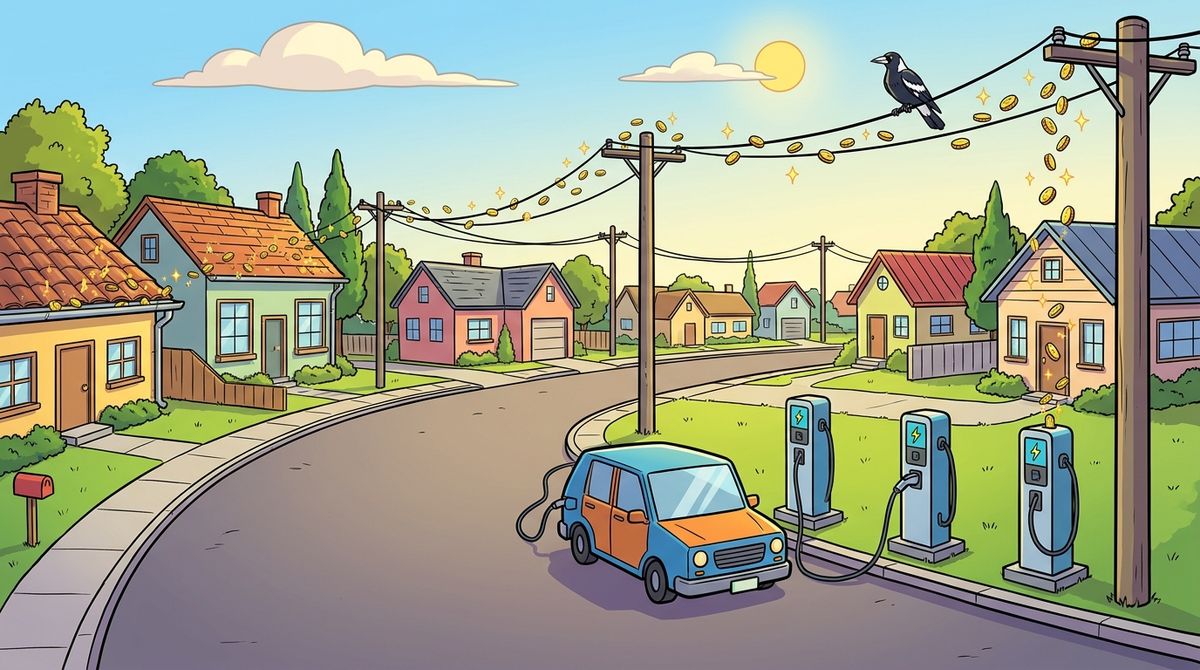
On 24 September 2026, the Australian Energy Market Commission (AEMC) handed down a draft ruling that could change who pays for public EV charging in Australia — and the answer, for now, is everyone.
The commission has given preliminary approval to a federal government proposal that would allow electricity network companies ("poles-and-wires" businesses) to install public EV chargers and recover the cost from all customers on the grid, whether or not they own an electric vehicle. The determination would apply across the National Electricity Market, covering Australia's entire eastern seaboard.[1]
The ruling comes at a remarkable moment for Australian transport. In August 2026, electric vehicles outsold petrol-powered cars for the first time, with battery-electric models taking 24.9 per cent of new car sales, and the national fleet passed 500,000 battery-electric vehicles on World EV Day earlier this month.[2][3] Yet Australia still has fewer than 4,000 public chargers — one of the lowest EV-to-charger ratios in the developed world.[1]
What the draft ruling actually says
The proposal is more targeted than the headline suggests. Under the draft decision:
- Network companies would be required to support commercial charging providers wanting to install hardware in "high density" inner-city areas — for example by making connections and network capacity available. Where private operators don't take up identified sites, networks could step in as a "supplier of last resort". The same logic would apply to regional "charging blackspots" where the private business case is weak. The arrangement would only apply to infrastructure delivered under a specific Commonwealth program, running for five years from mid-2029.
AEMC chair Anna Collyer said the ruling would help release $40 million of federal funding, which would cover about 30 per cent of 14,000 chargers "where they are most needed", with networks recovering the remainder from consumers — adding roughly $1 a year to a typical household electricity bill.[1]
> "It's looking at areas of potential market failure... given the uptake that we've seen in EVs from the fuel crisis, the Commonwealth wants to make sure the charging infrastructure is keeping up with that and to remove barriers for people who may be considering an EV."
— Anna Collyer, AEMC chair[1]
Collyer framed the cost as minor relative to the payoff, arguing the emissions-reduction benefits "would accrue to everyone", and pointing to two specific gaps: apartment dwellers and others without off-street parking in inner cities, and patchy regional coverage fuelling range anxiety.[1]
The other side: "no market failure here"
The draft ruling has enraged parts of the charging industry, which argues Australia's public charging market is already competitive, privately funded and working.
Ross De Rango, director of Vehicle Charging Solutions Australia, said there was no market failure to fix, and warned the decision would hand a competitive market to regulated monopolies whose revenues are guaranteed regardless of performance.[1]
> "The public-facing EV charging infrastructure in this country is virtually entirely competitively owned. There is no need for public charging infrastructure to be owned by monopolies where it can be owned by competitive interests instead."
— Ross De Rango, Vehicle Charging Solutions Australia[1]
De Rango's concern is scale. He estimates Australia will need around $20 billion worth of public EV charging equipment installed over the coming decades — all of it to be installed, maintained and eventually replaced. Letting networks own that equipment, he argues, removes the pressure to place chargers well and run them efficiently.[1]
Stewart Joyce, chief executive of the National Electrical and Communications Association, was blunter, saying the decision "shows staggering contempt for consumers battling in the midst of a cost-of-living crisis".[1]
Why the government is pushing it
The policy backdrop matters. Federal Labor has spent 2026 leaning into electrification as a cost-of-living response, and the fuel price shock that began in March has done more to move buyers than any subsidy: more than 108,000 battery-electric cars were sold between March and July 2026, up 142 per cent on the same period in 2025.[3]
August's sales figures marked a symbolic crossover — petrol and diesel combined fell below half of new vehicle sales for the first time — but infrastructure is lagging demand. The federal program behind the AEMC ruling is designed to close that gap in the two places the market struggles to reach on its own: dense inner suburbs where connection costs and kerbside access make chargers hard to site, and regional corridors where traffic volumes don't yet support a private operator.[1][2]
The numbers behind the gap
The scale of the shortfall explains why the Commonwealth is willing to test a contested model. Consider the arithmetic:
- 500,000+ battery-electric vehicles now on Australian roads, against fewer than 4,000 public chargers.[1][2] 14,000 chargers targeted under the federal program, with the $40 million contribution covering roughly 30 per cent of their cost.[1] ~$1 per year added to a typical household bill to recover the network-funded share — a figure the AEMC says is more than offset by economy-wide emissions benefits.[1] $20 billion in cumulative public charging investment estimated to be needed over coming decades, according to the charging industry itself.[1]
The AEMC's bet is that a modest, time-limited backstop — five years, tied to one Commonwealth program, triggered only where private operators pass on a site — can accelerate rollout without smothering the competitive market that built most of the existing network. Critics counter that regulated monopolies rarely stay in a supporting role once given a foot in the door, and that every charger a network owns is one a private operator was willing to risk capital on.
What it means for EV drivers, fleets and regional owners
The direct dollar impact on most households is trivial — about a dollar a year. The more interesting consequences are structural:
- Regional drivers stand to benefit most. If "charging blackspots" genuinely get filled by suppliers of last resort, routes that are currently marginal for EVs — and for electric utes towing, or converted 4x4s used on properties — become more viable. Inner-city apartment dwellers get a second pathway to charging beyond strata retrofits, though the detail of how kerbside chargers will be sited and priced is still to come. Private charging networks keep competing in the profitable segments, with the network backstop only triggered where they decline to build. The risk to watch is scope creep: the industry fear is that a "supplier of last resort" role quietly becomes a dominant market position, with all customers underwriting underused assets.
Consultation on the draft ruling runs for six weeks, with a final determination due by the end of 2026. Anyone with a stake — fleets, regional businesses, charging operators, or drivers who simply want a charger on their nearest highway — has a window to make a submission.[1]
How to have your say
The draft ruling is not final, and the AEMC has a track record of adjusting draft positions after consultation. Submissions are open for six weeks via the AEMC website, with a final determination expected before the end of 2026.
If you rely on public charging — whether as a regional tradesperson, a fleet operator, a grey nomad weighing up an electric tow vehicle, or a strata committee trying to sort kerbside charging — this is the rare policy window where a single submission can shape site selection on routes you actually use. The commission's own framing, "high density" inner-city areas and regional "blackspots", means the definition of those zones will effectively decide where thousands of chargers appear.[1]
The bottom line
A dollar a year is not the story. The story is whether Australia's charging build-out is best run as a competitive market with a safety net, or as regulated infrastructure with a competitive fringe. The AEMC has landed — cautiously, and in draft form — on the safety-net model, targeting the two gaps the market has consistently failed to fill: the kerbside and the bush.
For the growing number of Australians running electric vehicles for work, towing or regional travel, the practical takeaway is to watch the final determination in December, and to have your say during consultation if your routes or depots depend on public charging.
The Australian EV Group's work converting 4x4s, utes and vans across regional Australia makes one thing clear: charging certainty is now part of the electrification business case, whatever form the final rules take.
Sources
1. ABC News, "Plan to slug consumers for EV chargers gets regulator backing", 24 September 2026. https://abc.net.au/news/2026-09-24/plan-to-slug-consumers-for-ev-chargers-gets-regulator-backing/107187978
2. Electric Vehicle Council, "Australia hits half a million battery electric vehicles — and the real race is just starting", September 2026. https://electricvehiclecouncil.com.au/media-releases/australia-hits-half-a-million-battery-electric-vehicles-and-the-real-race-is-just-starting/
3. The Driven, "Australia's dramatic electric U-turn: everyone knows someone with an EV", 8 September 2026. https://thedriven.io/2026/09/08/australias-dramatic-electric-u-turn-everyone-knows-someone-with-an-ev/