
The World's Biggest Electric Ship Was Built in Tasmania. Here's How It Works
By Jason Rieck
Co-Founder & Lead Designer, Cat Cruisers
The biggest battery-powered vehicle ever built didn't come out of a Silicon Valley lab. It came out of a shipyard in Hobart. Hull 096, a 130-metre catamaran ferry built by Tasmanian shipbuilder Incat, has arrived in South America. It will carry passengers and cars across the River Plate between Buenos Aires in Argentina and Colonia in Uruguay.
The story was shared by Engineers Australia, drawing on Joe Ennis's feature in its create magazine, "This is the largest all-electric vehicle ever made". You'll find links to both at the end. Here's our plain-English look at how a ship this big can run on batteries alone.
How big is the battery?
The ferry carries more than 5,000 battery modules. Together they weigh over 250 tonnes and store about 40 megawatt-hours of energy. According to create, that's four times larger than any other battery system ever installed on a ship. Incat's CEO, Stephen Casey, called it "the largest electric vehicle of any kind ever built".
A megawatt-hour is simply a thousand kilowatt-hours, the same unit on your power bill. Think of it as the size of the fuel tank, not how fast the fuel is used. For a sense of scale, a Cat Cruiser carries a 60 kWh drive battery. The ferry's battery could fill roughly 670 of those, which makes sense for a ship carrying 2,100 passengers and 225 vehicles.

Heavy pack, light everything else
Picture a hiker with a very heavy backpack. You can't make the pack lighter, so you save weight everywhere else: lighter boots, a lighter tent, less stuff.
The engineers did the same. The hull is aluminium, which is lighter than steel. create reports the ship's waterjets were designed to be "tens of tonnes lighter than on previous Incat installations", helping offset the weight of the batteries. The team also had to balance where all that weight sits and fine-tune the ship's stability. The less a boat weighs, the less energy it takes to push it through the water.

Push water back, go forward
If you've ever held a garden hose on full blast, you've felt it push back against your hand. Hull 096 works on the same idea. Eight electric motors drive waterjets, which are powerful pumps that suck water in under the hull and fire it out the back. Push water backwards and the ship moves forwards.

The hull shape helps too. Its lightweight catamaran hull is designed to slip through the water with as little drag as possible, a bit like a canoe compared with a bathtub. According to create, it cruises at about 25 knots and makes the crossing in about 75 minutes.
Top up at every stop
Most of us plug in our phones whenever we sit down for a coffee. The ferry does something similar. create reports that automated charging towers at each terminal top up the batteries in 60 to 90 minutes.

This is the clever part. Because the route is short and the same every day, the battery only needs enough energy for a crossing plus a safety margin, not for a trip around the world. That's also why the ferry couldn't sail itself to South America. With only around 90 minutes of running time, as Pulse Tasmania reported, it rode the whole way on the back of a giant heavy-lift ship.

Keeping 250 tonnes of batteries safe
Battery care is like looking after your body. Top priority.
On a ship carrying 2,100 people, the builders clearly agreed. create reports the design includes fire-resistant enclosures, advanced ventilation, thermal-runaway isolation and constant system monitoring.
In plain English: thermal runaway is when one overheating battery cell heats up its neighbours, like a row of falling dominoes. Isolation puts walls between the dominoes, like fire doors in a big building, so a problem stays in one room. Ventilation clears away heat and gases, and monitoring means something is always watching for the first wobble.

Why it matters
Hull 096 was originally designed to run on liquefied natural gas. "The decision to move from an LNG-powered design to a fully battery-electric vessel was driven by the opportunity to lead the industry towards net-zero emissions," Casey said. The result is no exhaust on the water and a much quieter ride. create also reports that all of the energy used to build the ship came from renewable sources.
And it's not a one-off. Incat has won a contract to build two battery-electric ferries for a Danish operator, and Pulse Tasmania reports it has more large electric ferries under construction in Hobart. Australia is quietly leading the world at this.
Our take
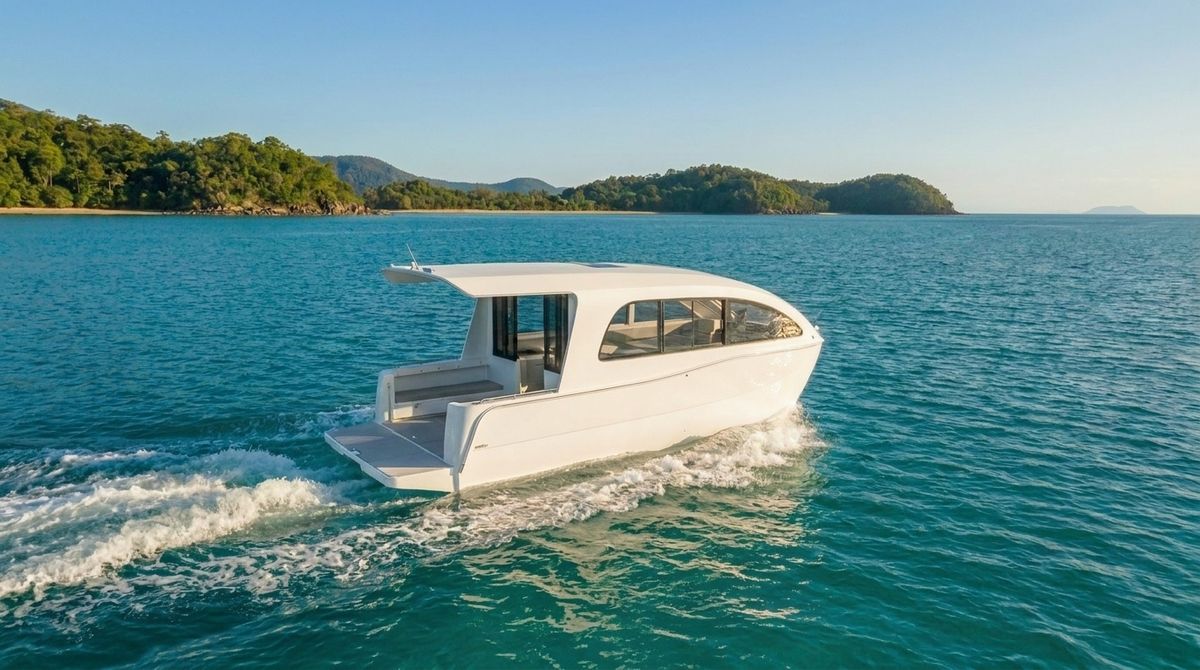
We build boats at the other end of the size scale. A Cat Cruiser is a trailerable electric catamaran: boat by day, caravan by night, with a 60 kWh drive battery, a separate house battery, 5,000 W of solar and a 1-hour fast charge. Hull 096 is a very different vessel, but the lessons scale down nicely: keep the weight down, keep the hull slippery, size the battery for how you'll really use it, and look after it.
Seeing a Tasmanian shipyard build the biggest electric vehicle on Earth makes us proud. It's a reminder that Australians can design and build world-class electric boats, big and small.