
You Can Already Tow a Caravan. Here's What Changes When the Trailer Carries a Boat.
By Jason Rieck · Gold Coast · 5 October 2026
Australia is a nation of towers. Roughly 937,000 registered RVs are on the road, their owners took 17.3 million caravan and camping trips in 2025, and almost all of those kilometres happened behind a towbar [1]. If you can reverse a caravan into a site and keep a 3-tonne combination steady at highway speed, you already own 90% of the skill a boat trailer demands.
But a boat trailer is not a caravan trailer. The load behaves differently, the environment is hostile in ways caravan gear never sees, and the consequences of one forgotten habit show up as seized wheel bearings on a boat ramp 40 minutes from home. Here's what transfers — and the four habits that don't.
What carries over completely
Weight discipline. Aggregate trailer mass, towball download, loading heavy items low and forward — identical maths, and boat trailers reward the same rigour. Exceeding the towball weight stated for the trailer, or loading the boat stern-heavy, creates the same sway and instability you'd get with a badly packed van [2].
The towing setup itself. Brake controller, mirrors, tyre pressures, extended mirrors where required — all the same. Your driving technique carries over: smooth inputs, generous following distance, no sudden lane changes.
Pre-trip checks. Lights, coupling, safety chains, breakaway systems — the walkaround you do before a van trip is the same walkaround before a boat trip.
Habit one: bearings are the boat trailer's whole life
This is the big one. Caravan hubs live in dust; boat trailer hubs live in water — launched and retrieved repeatedly, often fully submerged at the ramp. Water past the seals washes grease out, and ungreased bearings overheat, seize, and occasionally detach the wheel at speed.
The maintenance rhythm caravan owners never needed: grease the wheel bearings according to the manufacturer's schedule, and consider bearing protectors — pressure-greased caps that keep water out of the hub. If the trailer's been sitting through winter, a bearing check before the first trip is cheap insurance.
Rule of thumb: a hub that's too hot to keep your hand on after a tow is telling you something. Pull over before it tells you louder.
Habit two: saltwater rinse, every single time
A caravan gets rained on. A boat trailer gets dunked in seawater — which is corrosion with the volume turned up. Rinse the entire trailer, brakes included, with fresh water after every saltwater launch. It feels fussy the first dozen times and then becomes muscle memory, and it's the difference between a trailer that lasts decades and one that dissolves politely from the inside out.
Habit three: the ramp changes the reversing problem
Reversing a caravan into a site is slow, watched by nobody, with unlimited attempts. Reversing a boat trailer down a ramp is timed, often watched, with one lane and a queue behind you. The physics are the same; the pressure isn't.
Two things make it easier than it looks. First, the boat trailer is usually shorter and more responsive than a van — corrections happen faster, so steer smaller and earlier. Second, the winch post gives you a perfect visual reference down the centreline. Practise in an empty car park once with cones before your first busy Saturday ramp, the way you'd never take a van to a packed caravan park for your first reverse.
And the etiquette that costs nothing: get your boat ready — bungs in, straps off, gear loaded — before you back down, so you're off the ramp in one smooth sequence. The ramp is a loading zone, not a workshop.
Habit four: registration and rules are separate (and both required)
The boat needs its own registration, and so does the trailer — two number plates, two renewals, two sets of rules to stay on top of [3][4]. It's the detail that surprises exactly one person per ramp queue, usually on a long weekend.
The payoff
The caravan-to-boat crossover is one of the cheapest skill transfers in Australian recreation: the towing is the same, the maintenance discipline is stricter but simpler, and the ramp is a stage that rehearsal makes easy. Half a day of bearing maintenance, rinsing habits and one car-park reversing session, and the nation's most experienced towers become the nation's most competent boat launchers.
Cat Cruisers builds trailerable electric boats on the Gold Coast for exactly this owner — the family that already tows, already camps, and wants the water version of the same weekend.
Sources
- Caravan Industry Association of Australia — State of the Industry 2026, via GoRV coverage (registered RV fleet; caravan and camping trip volumes) The Fishing Website, "Boat trailer maintenance" (towball tongue weight limits; loading guidance) Dealify, "How much does it cost to own a boat?" (trailer registration requirements) My Boat Club, "The True Cost of Owning a Boat in Sydney" (NSW registration by vessel length)
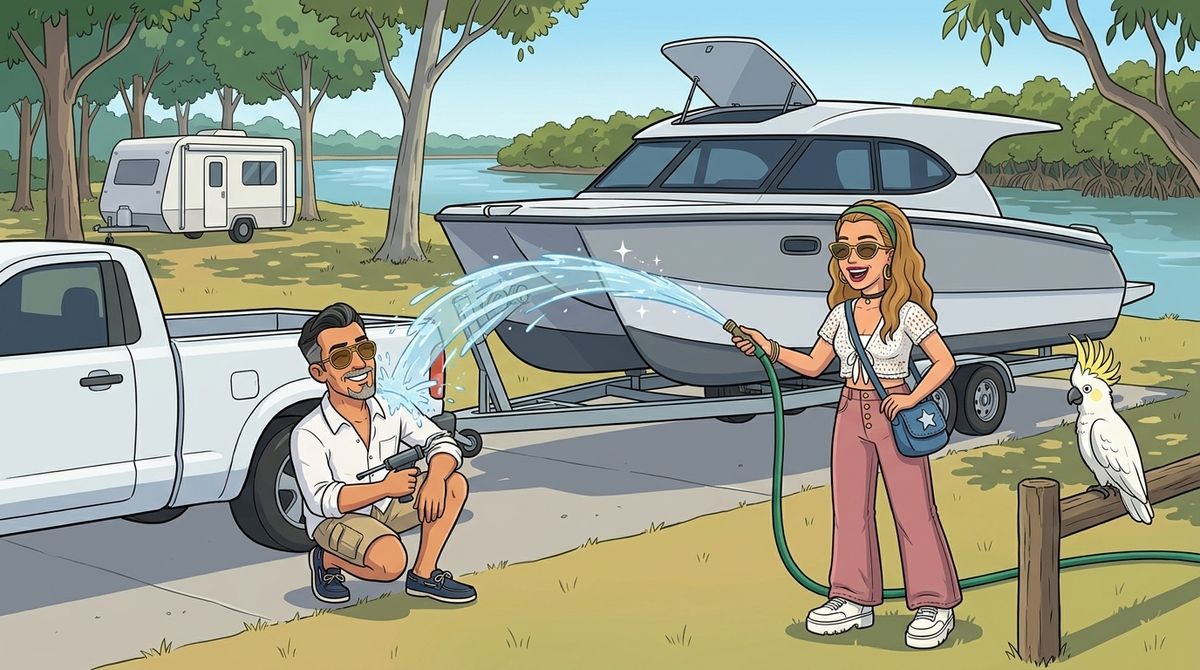
Cover illustration: JR & DJ cartoon by Cat Cruisers (AI-generated).