
Electric Boat-Caravans: A Practical Briefing for Tourism Operators, Marinas and Councils
By Jason Rieck
Co-Founder & Lead Designer, Cat Cruisers
Most of what we publish is for owners. This one is for the people who run the places owners go: tourism and accommodation operators weighing up a fleet, marina managers who'll see these vessels on their pontoons, and council and waterway staff who look after ramps, foreshores and anchorages. It covers what the vessels are, the regulatory questions a commercial operator has to answer, and the practical infrastructure points. It's general information, not legal advice. The authorities named below have the final word.
What the asset is
A Cat Cruiser is a fibreglass, trailerable, all-electric vessel in three lengths: 6.5, 7.5 and 8.7 metres. Each has twin inboard electric motors, LFP batteries, a rooftop solar array, an induction galley, electric hot water, a marine toilet with holding tank and a fresh water system. There's no gas on board. On the water it's a boat. Parked on its trailer at a powered site, it's self-contained accommodation. The largest model, the 870, has a 60 kWh drive battery, a separate house battery and 5 kW of roof solar, and draws just 0.2 m. More detail is on our commercial and fleet page.
For tourism and accommodation operators
Recreational or commercial. In Queensland, a boat registered as a recreational vessel must be used only for recreation (or for school, surf lifesaving or community activities), not for business, trade or commerce, as Maritime Safety Queensland makes clear. Once you charge guests to use a vessel on the water, you're in the national system for domestic commercial vessels, administered by the Australian Maritime Safety Authority (AMSA).
What AMSA requires. Unless an exemption applies, a domestic commercial vessel needs a unique vessel identifier displayed on the vessel, a certificate of survey, a certificate of operation and a safety management system, and crew need the appropriate certificates of competency. Hire-and-drive operations, where guests skipper the vessel themselves, are Class 4. They carry additional operating requirements under Marine Order 504, including pre-hire inspections, briefing hirers and keeping written hire records. Engage an accredited marine surveyor and talk to AMSA early. Survey is far easier to plan in from the start than to retrofit.
On land. Using a vessel as accommodation at a site is a separate question from marine law. Whether guests can stay aboard at a particular property depends on that site's existing approvals and the local council's planning scheme. A holiday park with approved powered sites is a very different starting point from a vacant waterfront block. Ask the council early, and get the answer in writing.
Why all-electric helps an operator. No gas means no LP gas installation to maintain and have inspected, no cylinders to store or swap, and no combustion appliances in the sleeping space. No fuel means no refuelling logistics and no fuel spills at the jetty. Quiet electric running suits guests and neighbours at dawn and dusk. And because the asset is trailerable, it can move between sites or seasons rather than being locked to one location. For individual owners, we also run an optional managed charter program.
For marina managers
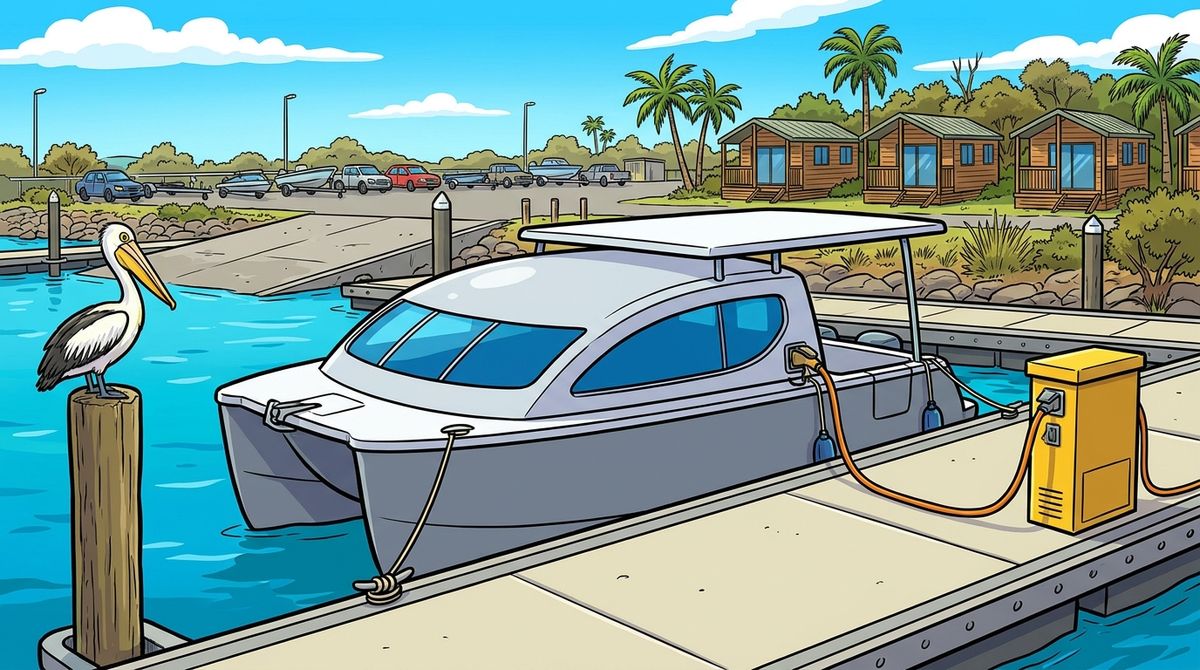
Shore power. Charging demand is the new consideration. At 230 volts, a 10-amp outlet delivers about 2.3 kW and a 15-amp outlet about 3.45 kW. Six vessels charging overnight at 15 amps is up to around 21 kW of sustained load, for hours at a time. Many older pedestals and supply arrangements weren't designed for sustained charging of large battery banks, so check circuit and supply capacity before you promise charging. A 15-amp outlet can put back roughly 35 kWh over a 10-hour night, which is a bit over half of an 870's 60 kWh drive battery. The 870 can also fast-charge in about an hour on a suitable fast charger. Moving 60 kWh in an hour implies a charger in the order of 60 kW, which means dedicated DC fast-charging infrastructure with its own supply, not a pedestal upgrade. Electrical installations in marinas are covered by AS/NZS 3004.1, and those in boats by AS/NZS 3004.2.
Berths, hardstand or short stays. These vessels are trailerable, so many owners won't want a permanent wet berth. The opportunity is more likely to be short-stay berths with charging, secure car-and-trailer parking, and good ramp access than annual contracts.
Batteries on the pontoon. Lithium iron phosphate is among the most thermally stable of the mainstream lithium chemistries. Your fire and emergency plans should still account for lithium batteries on vessels in your facility, as they increasingly should for every electric boat, e-bike and car on site. Talk to your insurer and your local fire service.
For councils and waterway managers
Ramps and parking. A larger Cat Cruiser on its trailer is a long rig before you add the tow vehicle, so these need long-trailer bays and room to manoeuvre. When ramps are upgraded, trailer parking length and turning space matter as much as lane width.
Anchoring. Overnight stays at anchor are part of the appeal, and local rules apply. On the Gold Coast, for example, the Gold Coast Waterways Authority enforces time limits. In the 7-day areas of the Broadwater, a vessel can anchor for up to 7 consecutive days in any 60-day period. In the 24-hour areas, which include most of the rivers and canals, the limit is 24 hours in any 30-day period. Clear maps and signage help visitors comply.
Sewage. Every model has a marine toilet with a holding tank. Queensland's marine pollution rules, administered by Maritime Safety Queensland, include nil-discharge waters where sewage must not be discharged, so holding it aboard and pumping out ashore is the norm. Pump-out facilities near ramps and anchorages make compliance easy. Without them, it gets hard.
Emissions and noise. Electric propulsion produces no exhaust on the water and far less noise than a combustion outboard. That matters in residential canals, next to foreshore parks and in sensitive habitat. Our article on quiet electric boats and marine life covers the science.
A short checklist
- Operators: commercial pathway (AMSA survey, certificate of operation, safety management system), site and planning approvals, and insurance for commercial use.
- Marinas: charging capacity per pedestal and per supply, car-and-trailer parking, and lithium batteries in emergency plans.
- Councils: long-trailer parking at ramps, pump-out access, and clear anchoring information.
If you're weighing up a fleet or planning infrastructure for electric vessels, commercial conversations start with me directly. See the commercial page or get in touch.