
Inside the Electric Drive: Twin Motors, Two Batteries and the Six-Hour Day
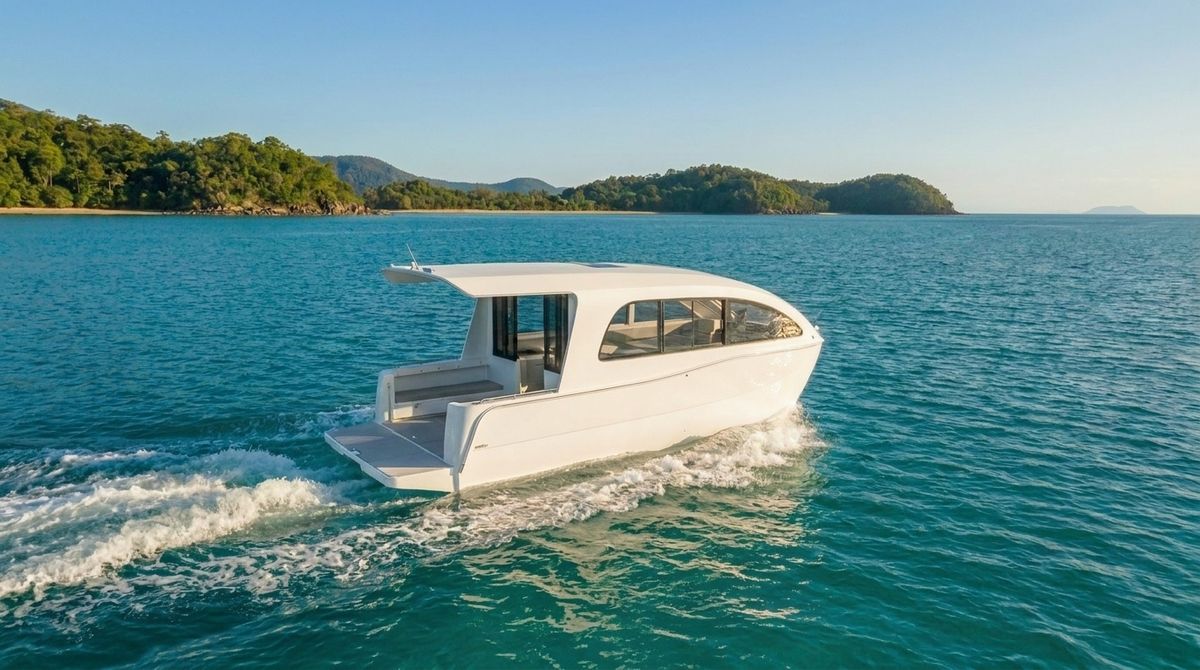
By Jason Rieck
Co-Founder & Lead Designer, Cat Cruisers
If you drive an EV or have rewired a boat, you want to know how the system is put together, and why. This one is for the engineers, the EV owners and the experienced boaties. It uses our current figures for the 650, 750 and 870, and it labels every estimate as an estimate.
The numbers
Everything below works from these figures. Specifications are subject to final engineering and certification.
- 650: twin 5 kW inboard electric motors and an LFP drive battery.
- 750: twin inboard electric motors and an LFP drive battery.
- 870: twin 10 kW inboard electric motors, a 60 kWh drive battery, a separate lithium house battery, and 5,000 W (5 kW) of roof solar. It can fast-charge in about an hour on a suitable fast charger.
- Runtime: about six hours of continuous running at cruising speed on a full charge, without solar. Our model pages quote runtime at 5 knots, which works out to roughly 30 nautical miles in still water.
Why system voltage matters
Electrical power is voltage multiplied by current. To deliver 10 kW, one of the 870's motors at full rating, a 12-volt system would need about 833 amps. At 48 volts it is about 208 amps, and every doubling of voltage halves the current again.
That matters because resistive loss in a conductor scales with the square of the current. Halve the current through the same cable and the heat lost in it drops to a quarter. In practice a higher system voltage means thinner, lighter cabling for the same power, less voltage drop along the run from battery to motor, and connections that run cooler. On a boat, where every kilogram costs range and every hot joint is a maintenance item, that is a real gain.
So why not go as high as the 400-volt and 800-volt systems in modern cars? Under Australian and New Zealand wiring rules, extra-low voltage tops out at 120 volts ripple-free DC. Staying inside the extra-low voltage band keeps shock risk and installation complexity in a far more manageable place for a small craft that also plugs into campsites and marinas. That's the trade-off a boat's drive voltage sits on: high enough to keep currents sensible, low enough to stay extra-low voltage.
Why two motors, and a separate house battery
Every Cat Cruiser has two motors. Splitting the drive into two systems means a problem on one side can be contained to that side, rather than taking the whole boat with it. Two drives also make differential thrust possible. At low speed, one motor ahead and the other astern will pivot a wide platform in very little space, which is exactly what you want at a crowded ramp or in a tight marina fairway.
On the 870, the caravan side runs from its own lithium house battery, so cooking, lights and the fridge don't draw on the drive battery.
Battery installations in caravans and other connectable installations are covered by AS/NZS 3001.2, which since its 2022 revision has included specific battery storage requirements.
Why LFP chemistry
Lithium iron phosphate carries less energy per kilogram than the nickel-based chemistries common in cars. We accept that. In return you get a chemistry that is far more thermally stable and tolerant of abuse, with a long cycle life. For a vessel where people sleep aboard, that is the right side of the trade. There is more detail in our LiFePO4 vs NMC comparison.
The six-hour day, worked through
Divide battery capacity by runtime and you get the average power the drive is using. These are estimates. They assume the whole battery is usable and nothing is held in reserve.
- 870: 60 kWh ÷ 6 hours ≈ 10 kW average. That's half the 20 kW combined rating of its two 10 kW motors.
The headroom between average draw and motor rating isn't for cruising. It's for pulling away from a ramp in a crosswind, holding station in a tidal run, and the occasional burst when you need to get somewhere.
Solar changes the picture, but not as much as people hope. The 870's 5 kW array realistically delivers about 4 kW at midday, once heat, flat mounting and conversion losses take their share. On a good Gold Coast day it harvests roughly 20 kWh (5 kW × about 5 peak sun hours × about 80 per cent). At a 10 kW average draw, that's about two extra hours, so a sunny day stretches the running day to roughly eight hours, and closer to nine on a long, clear summer day. Since 4 kW of solar is less than half of a 10 kW cruising draw, solar extends the day rather than replacing the battery. Its bigger job is refilling the battery while you're at anchor.
Why cruising speed is everything
Every displacement hull has a speed where wave-making resistance starts to climb steeply. The classic rule of thumb puts that "hull speed" at about 2.43 times the square root of the waterline length in metres, in knots. For waterlines in the six-to-eight-metre range, that lands at around 6 to 7 knots. The 870's shallow-draft catamaran hull is built for stability and shallow water, not for outrunning that curve.
Below that knee, power scales roughly with the cube of speed. Going 20 per cent faster needs about 1.7 times the power, so on the same battery a six-hour day becomes roughly three and a half hours, and you cover about 30 per cent less distance. Speed is the most expensive thing you can buy on an electric boat. Our range explainer goes deeper on the cubic curve, and Electric Catamarans Explained covers why multihulls suit electric power.
Questions worth asking any electric boat builder
Whoever you buy from, these are the questions that separate a brochure from an engineering conversation:
- What is the usable battery capacity, as opposed to the nameplate capacity?
- At what speed and load is the runtime quoted?
- What does the measured consumption curve look like, in kilowatts against knots?
- What charge rate does the boat accept on 10-amp and 15-amp supply, and on a fast charger?
- Which standards does the marine electrical installation comply with?
If you'd like to go through any of these for a specific model, the 650, 750 and 870 pages carry our specifications, and you can talk to us directly.