
What Is a Cat Cruiser? A Plain-English Guide to the Boat That's Also a Caravan
By Jason Rieck
Co-Founder & Lead Designer, Cat Cruisers
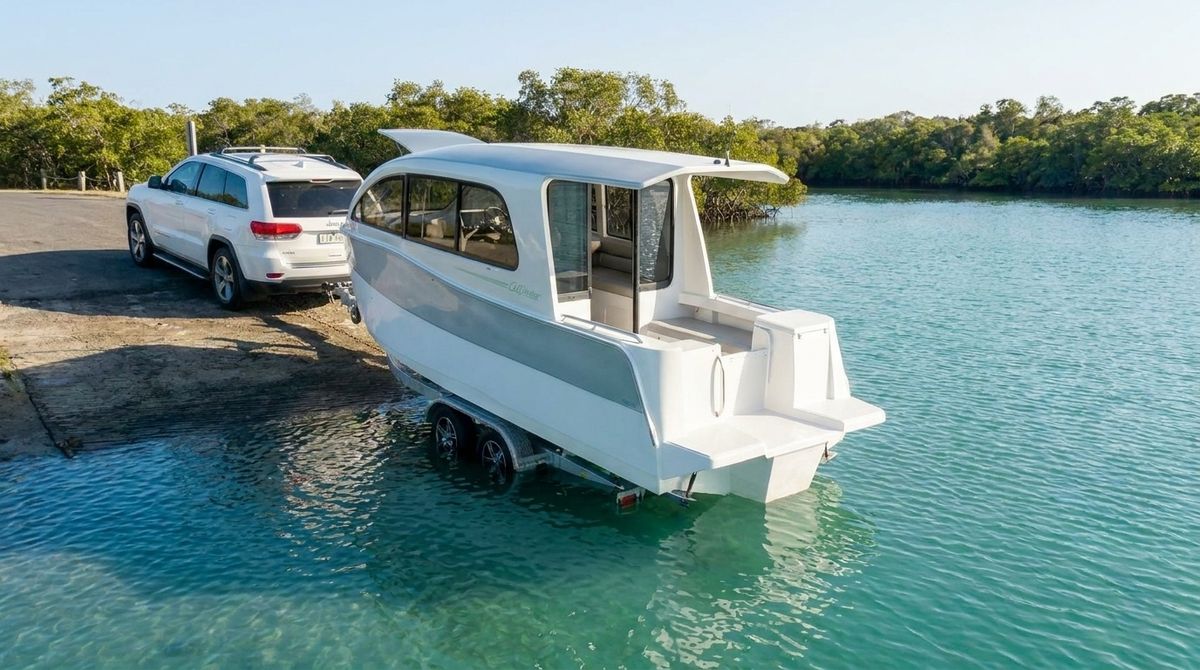
Here's the short version: a Cat Cruiser is a boat by day and a caravan by night. It's an all-electric catamaran you tow behind your vehicle, launch at a boat ramp and cruise all day. Then you can either sleep aboard at anchor, or tow it back to a campsite and sleep in it there. One vessel, two kinds of holiday.
If you've never owned a boat or a caravan, that probably raises a dozen questions. This guide answers the big ones in plain English.
How a weekend actually works
Think of it in four steps.
- Land. Hitch it to your vehicle and drive to wherever you're going: a coastal campsite, a lake, a river town.
- Transition. Back the trailer down a public boat ramp and float it off, the same way thousands of Australians launch trailer boats every weekend.
- Sea. Cruise, swim, fish, or find a quiet beach for lunch. The motors are electric, so there's no engine roar and no fuel smell.
- Return. Bring it back to the ramp, winch it onto the trailer, and drive to your campsite or home.
A typical Saturday might look like this. Coffee at the campsite, then on the water by mid-morning. Lunch at anchor off a sandbar. A slow cruise in the afternoon, then back on the trailer and plugged into a powered site before dinner. Or skip the campsite and spend the night aboard at anchor instead. That's the whole idea: you decide each day.
What's on board
- A cabin you can sleep in, with a proper galley: an induction cooktop and a fridge.
- A marine toilet with a holding tank and a fresh water system. The 750 and 870 add a shower.
- Electric hot water, LED lighting, a premium sound system, and wiring ready for satellite internet.
- Solar panels on the roof that top up the batteries while you're out.
- A full safety equipment package.
There's no gas bottle anywhere. Cooking, hot water and everything else runs on electricity.
The three models, simply
- 650: compact. 6.5 metres long, twin 5 kW electric motors, room for six people on the water, and sleeping for four. It's the lightest to tow, at around 1,750 kg on its trailer, so it suits a wider range of vehicles.
- 750: the flagship. 7.5 metres, room for eight on the water, standing headroom in the cabin, and a shower. It needs a tow vehicle rated to tow 3,500 kg braked.
- 870: the grand tourer. 8.7 metres, twin 10 kW electric motors, a 60 kWh drive battery, a longer rear deck and roof access. It's the heaviest to tow, especially once loaded, so it needs a tow vehicle rated to tow 3,500 kg braked.
All three are rated for about six hours of continuous running on a charge at cruising speed (quoted at 5 knots, roughly 9 km/h). That's a relaxed pace, built for exploring rather than racing. On the 870, 5 kW of roof solar stretches a sunny day to roughly eight to nine hours, and it can fast-charge in about an hour on a suitable fast charger. If you want to understand the electric side in more depth, our complete guide to electric boats is a good place to start.
Who it suits
- Families who want the beach, the bay and the campsite in one trip, without packing for two separate holidays.
- Caravanners who keep parking next to beautiful water and wishing they could get out on it.
- Anglers who want to be on the water early from a quiet ramp, with a bed and a kettle aboard.
- People who don't want a marina. It lives in your driveway or shed, not in a paid berth.
- Anyone who's had enough of engine noise and fuel smell.
Who it probably doesn't suit
Being honest here saves everyone time. If you want to run 30 knots offshore to the fishing grounds, this isn't that boat. If your vehicle can't legally tow the model you want, that's a hard stop until it can. And if you have nowhere to keep a trailer, you'll need to sort that out first.
What you'll need
- A boat licence. You'll need a recreational marine licence to skipper it, as you would for most powered boats. In Queensland, Maritime Safety Queensland requires a licence for any boat with an engine over 4.5 kW.
- A suitable tow vehicle. Check your vehicle with our free Can You Tow It? tool before anything else.
- Registration. The boat and the trailer are registered separately, as with any trailer boat. Our state-by-state registration and licensing guide explains how it works where you live.
- Somewhere to plug in. A power point at home tops up the batteries between trips.
Where to next
For a feel of the lifestyle, The Experience page walks through a weekend. If you're new to overnighting on the water, Boat Camping 101 covers the basics. For the specifications, start with the 650, 750 or 870. And if you'd rather just talk it through, get in touch.