
Off-Grid by Design: Charging, Solar and House Power on an All-Electric Boat-Caravan
By Jason Rieck
Co-Founder & Lead Designer, Cat Cruisers
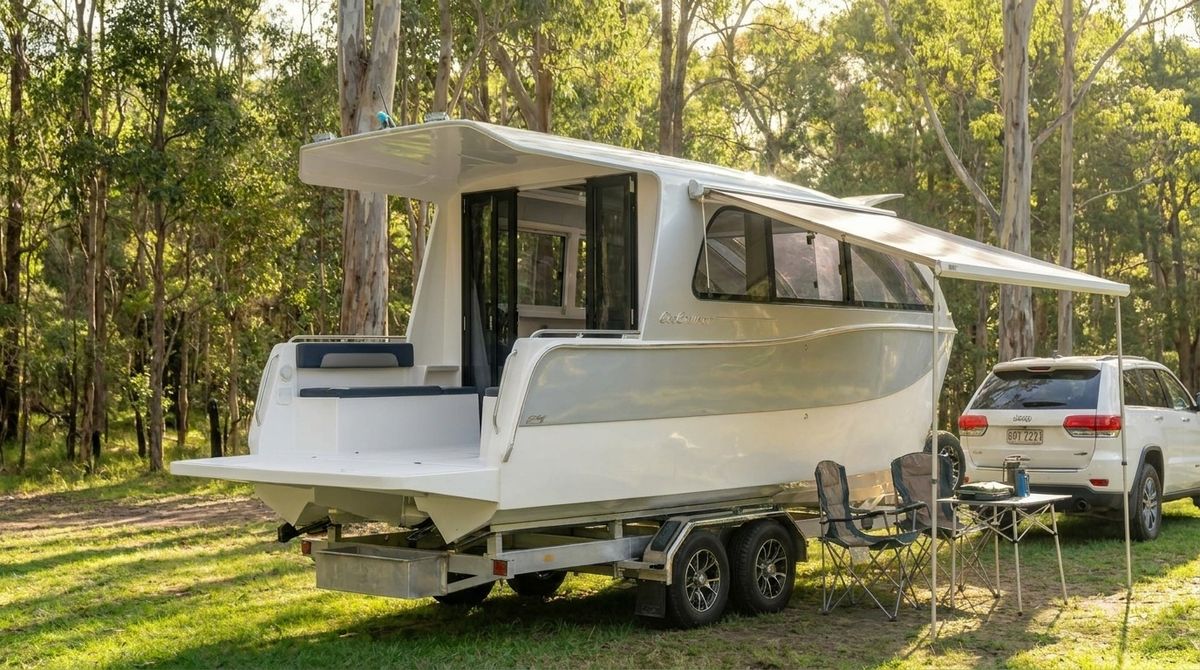
A conventional boat carries fuel for the engine and, if it has a cabin, a gas bottle for the stove. A caravan carries gas as well, plus a house battery and often a generator. A Cat Cruiser carries no fuel at all. There's no gas or LPG on board. The motors, the induction cooktop, the hot water, the fridge and the lights all run on electricity, and every kilowatt-hour comes from the power point you plugged into, the sun, or what's already stored in the batteries.
This article is for people who like to see the energy budget: EV owners, off-grid caravanners and anyone who has sized a solar system. It focuses on the 870 and shows the working. Estimates are labelled as estimates.
The numbers
Every calculation below uses these figures. Change one here and the working follows.
- 870 drive battery: 60 kWh.
- 870 runtime without solar: about six hours of continuous running at cruising speed (our model pages quote runtime at 5 knots).
- 870 roof solar: 5,000 W (5 kW).
- 870 house battery: a separate lithium battery for the caravan side.
- 870 fast charge: about an hour on a suitable fast charger.
- 650 and 750: smaller drive batteries and smaller recommended solar arrays than the 870.
Estimates derived from those figures:
- Average drive draw (estimate): 60 kWh ÷ 6 h ≈ 10 kW, assuming the full battery is usable.
- Midday solar output (estimate): about 4 kW, or roughly 80 per cent of nameplate once heat, flat mounting and conversion losses are counted.
- Daily solar harvest (estimate): 5 kW × about 5 peak sun hours × about 80 per cent ≈ 20 kWh on a good Gold Coast day, and up to about 28 kWh on a long, clear summer day with around 7 peak sun hours.
What solar does while you're running
With the sun out, solar offsets part of the drive draw. Add a good day's harvest to the battery and divide by the average draw: (60 + 20) kWh ÷ 10 kW ≈ 8 hours. On a long summer day, (60 + 28) ÷ 10 ≈ 9 hours. So solar stretches a six-hour running day to roughly eight to nine hours on a sunny day.
It can't do more than that at cruising pace. Peak solar is about 4 kW and the drive averages about 10 kW, so even at noon the battery is still supplying most of the power. Solar extends the day. It doesn't replace the battery.
What solar does at anchor
This is where the array earns its keep. At about 20 kWh per sunny day, refilling a completely flat 60 kWh battery on solar alone takes about three sunny days (60 ÷ 20). In practice you rarely run flat. Cruise for three hours, using about 30 kWh, and a day and a half of sunshine at anchor puts it back. Topping up, rather than refilling from empty, is the normal pattern. Cloud, winter sun and shade from trees at a campsite will cut the harvest, sometimes sharply.
For the smaller models, the same method (array size × peak sun hours × efficiency) applies to their smaller arrays.
Plugging in
A standard Australian 10-amp power point at 230 volts supplies about 2.3 kW continuously. A 15-amp outlet lifts that to about 3.45 kW. That's the type most caravan park sites provide, and the plug type AS/NZS 3001.2 identifies as most common for caravans and other connectable installations.
Those outlets set hard ceilings. Refilling 60 kWh from flat would take roughly 26 hours at 10 amps, or about 17 hours at 15 amps, before charger losses. A night on a powered site, say 10 hours at 15 amps, puts back roughly 35 kWh. That's more than half the battery, and the sun can do the rest. For the basics, see our guide to charging an electric boat.
The 870's one-hour fast charge is a different class of supply. Moving 60 kWh in about an hour means a charger in the order of 60 kW, which is DC fast-charging infrastructure, not a power point. When you have access to a suitable fast charger, it turns a flat battery around over lunch. Otherwise, a powered site and the sun are the everyday routine. Our article on solar panels on boats covers what solar technology can and can't do.
The caravan side of the budget
On the 870, the living loads run from the separate house battery rather than the drive battery. Typical overnight loads (general figures, not measurements from our boats) look like this:
- Induction cooking: a hob drawing around 1.5 to 2 kW for a 20-minute meal uses roughly 0.5 to 0.7 kWh.
- Hot water: heating 20 litres by 30 degrees takes about 0.7 kWh (mass × specific heat × temperature rise).
- Refrigeration: a modern compressor fridge typically uses half a kilowatt-hour to one and a half kilowatt-hours a day.
- Lights, devices, satellite internet: LED lighting barely registers, and a satellite internet terminal draws tens of watts while it runs.
A comfortable night is typically a few kilowatt-hours. Propulsion is the big consumer.
We plan to move the house battery to sodium-ion chemistry by the end of 2027. That's a plan, not a guarantee. Sodium-ion stores less energy per kilogram than lithium iron phosphate, but it avoids lithium and tends to cope well with cold.
Why no gas
LP gas installations in caravans and boats come with their own standard (AS/NZS 5601.2), cylinder storage and ventilation requirements, and the inherent risks of an open flame and combustion products in a small sleeping space. An all-electric galley and hot water system removes that whole category.
Two standards, one vessel
Parked and plugged in, an all-electric boat-caravan behaves like a caravan, and AS/NZS 3001.2 covers connectable electrical installations of that kind, including battery storage and venting. Our drive battery banks have venting compliant with that standard. On the water, AS/NZS 3004.2 is the standard for electrical installations in boats. If you're comparing electric boat-caravans, ask how the installation addresses both.
Power that flows the other way
Ask us about inverter/charger options if you'd like an external 240-volt outlet or home backup during a blackout.
A simple routine
- Charge fully before a trip, on a fast charger if you have one.
- Plan each day's running with a reserve you're comfortable with.
- At anchor or camp, let the solar top the battery up, and plug in when you can.
- Watch state of charge the way you'd watch a fuel gauge.
See the 650, 750 and 870 pages, or get in touch to talk through your own energy budget.